Community Health Workers are the backbone of Polio fight
Protecting children from polio

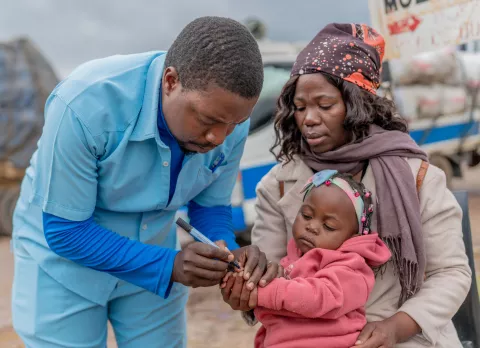
Misozi Bisayanii, 39, is happy that her last-born son, Joseph, retook polio vaccine shots at home two months after Malawi confirmed the first case in three decades.
On 28 March 2022, the Ministry of Health launched the first round of the nationwide campaign, with a target to vaccinate 2.9 million children aged under five to stop the spread of the crippling last detected in 1992.
"For days, a community volunteer in our community had been telling us that a child in Lilongwe was recently found with polio, the first of its kind in many years. This means no child will be safe unless every child is vaccinated," said Misozi after her son received two polio vaccine drops around 5.30 pm.
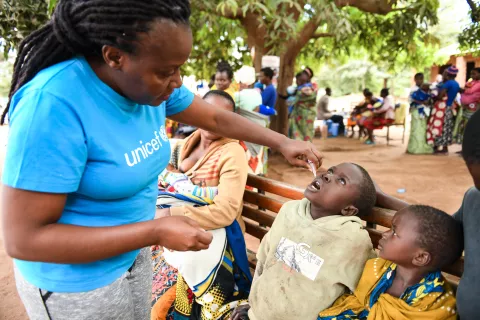
The four year old was the last to be vaccinated on the sunny Wednesday by a team led by Alice Kalima, senior health surveillance assistant at Kangolwa Health Centre in Ntchisi.
However, he becomes her first child to receive a vaccine in the comfort of her home, where she sells soap and other groceries.
"This is the first time health workers in my area have come to vaccinate a child at home and it left me with no excuse for my son to miss his shot. I am happy that my children are protected and I didn't waste any time or money in the process. ," says the happy mother ..
Once every month, Misozi leaves home around 7 am to make a 90-minute trip to Chimbindu Village where children receive routine vaccination.
She often returns home after noon, sacrificing about five hours just to shield the child from vaccine-preventable diseases.
"With the door-to-door campaigns, I can use the time saved to take care of my family, crops and the shop that makes K5 000 a day," Misozi explains.
Such tales are common in rural areas, where 84 per cent of Malawians live, according to the 2018 national census. Health facilities are far apart.
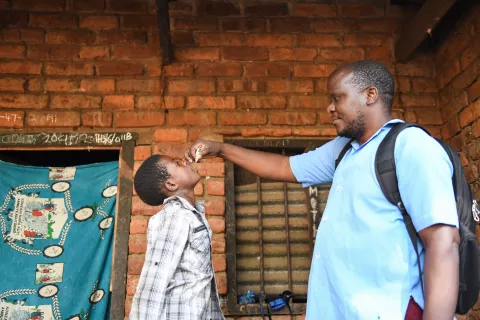
To deliver vaccines to children in their homes, senior Health Surveillance Assistant Alice has to walk over hills and valleys dotted with unplanned settlements.
Her panting said it all.
"Joseph is the 91st child we have vaccinated since morning. All day, we have surmounted tricky footpaths, deep gullies, snaking streams and overgrown valleys as homes are not only far apart but also connected by rocky, bumpy and narrow footpaths," she narrated.
Overcoming the barriers makes the first phase of the polio vaccination campaign one of the chilling but exciting challenges in her seven-year career as an HSA.

"Since I chose this calling, I have to go where my services are needed most because far-flung populations will suffer exclusion and die from preventable conditions such as polio if I shun them."
Her team vaccinated 94 children the day the vaccination campaign kicked off, 62 on day two and 91 on the third day.
As a team leader, Alice had to wake up as early as 6 am, making the one-hour-a-half trip from her home in Chimbindu Village. A return trip on a motorbike costs K1 400, the cost the locals pay to present their children for routine immunisation there.
"It is amazing that we can vaccinate 91 children in their homes. We usually get about 40 during monthly clinics in Chimbindu. This confirms that long walks and high travel costs prevent some children from accessing vaccines," she says.
safely tucking the remaining vaccine doses between cool packs in a blue box.
The cool boxes keep the sensitive vaccines chilled and effective for six to eight hours lest they perish if exposed to high temperatures.
"No dose must go to waste before reaching a child at risk of polio. Even a single case is an emergency," says Alice, who supervises 14 other HSAs at Kangolwa Health Centre.
Malawi is part of a regional push to kick out polio by vaccinating 9.4 million children in eastern and southern Africa. The case detected in the capital city Lilongwe has prompted similar campaigns in Zambia, Mozambique and Tanzania.
UNICEF is working with governments in the four countries to eradicate a potential resurgence of the disease transmitted when one ingests water or food contaminated by faeces from an infected person.
In Malawi, the UN children's agency procured and distributed 6.8 million polio vaccine doses to all 865 health facilities nationwide.
Before the arrival of the vaccines from the Global Polio Eradication Initiative, UNICEF installed 170 new vaccine refrigerators, repaired 135 faulty ones, and distributed cold boxes as well as remote temperature monitoring devices.
"Before the campaign, we had 10 vaccine carriers for 16 HSAs, which were not enough considering that the polio vaccination campaign is running parallel with routine immunisation and Covid jabs. We thank UNICEF & EPI for giving us more vaccine carriers which helped us reach more people during the door-to-door campaign," Alice explains.

According to UNICEF Vaccine Management Specialist Lokesh Sharma, the shortage of vaccine carriers in the district gives a glimpse of a familiar challenge observed during cold chain assessments conducted in readiness for the campaign. UNICEF acted immediately and provided enough vaccine carriers and cool packs to all the districts before the campaign.
He salutes community health workers for keeping the boots firmly on the ground and hitting the road running to deliver the vaccine to children most at risk even in remote areas.
"HSAs are the backbone of this immunisation programme. Whatever we are doing is high-level coordination, but the ultimate delivery of services is done by the selfless health workers, who are doing an excellent job despite being overburdened by routine immunisation and COVID-19 vaccination campaigns. We are very grateful for their dedication because the huge investment in vaccine logistics means nothing if doses do not reach a child at risk of polio," explains Lokesh Sharma.
---
UNICEF, WHO and other partners of the Global Polio Eradication Initiative - Gavi, Bill and Melinda Gates Foundation, Rotary and Centers for Disease Control and Prevention, and the The German Federal Ministry for Economic Cooperation and Development (BMZ), are supporting the Ministry of Health to vaccinate all children under the age of five in four mass vaccination campaigns.