

#PlayYourPart campaign
Learn how you can implement this campaign and play your part to end violence against women and children.
- Français
- English
The campaign #PlayYourPart aims to address violence against women and girls (VAWG). It focuses on addressing the root causes and underlying circumstances, systems and conditions that support violence and gender inequality
The goal is to ensure that all women and girls, especially the most vulnerable, live a life free of violence. Although there is no single solution to such a complex problem, there is growing evidence of the range of actions that can prevent violence before it happens.
Social Behaviour Change Communications (SBCC) is one approach to social and behavioural change that can support VAWG prevention strategies. This is why #PlayYourPart features a package with a variety of tactics to tackle this issue and provides implementers practical guidance on how to design, adapt and implement country-level communication materials to complement and contribute to national efforts as part of their own multi-pronged SBC strategies.
The package is based on regional-level evidence and priorities and envisioned as “modular” to be adapted and integrated at country-level, to ensure consistency and synergy across Caribbean communities.
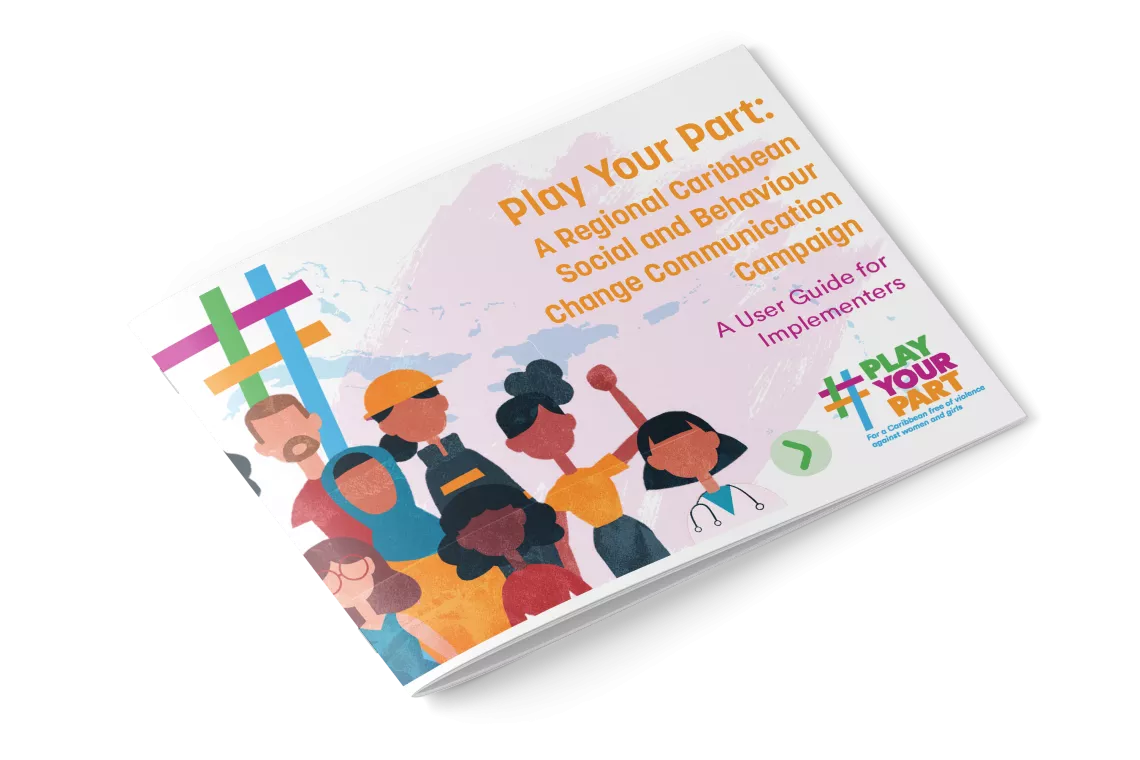
Download the User Guide and learn how to implement the campaign

Download audiovisual material



Radio Drama and Guide
Song, Music Video and Guide
Champions videos and Guide
Resources
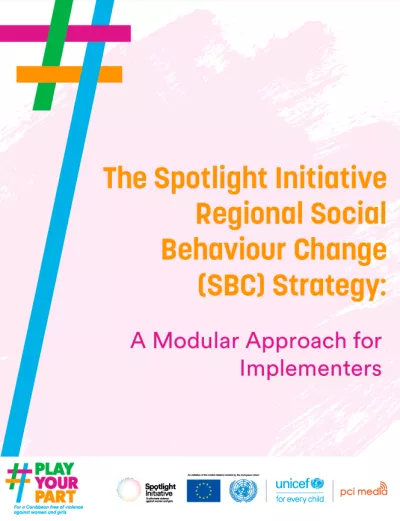
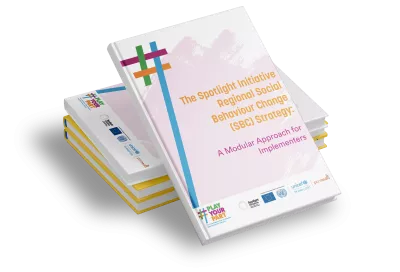
The Spotlight Initiative Regional Social Behavior Change (SBC) Strategy
The Spotlight Initiative (SI) is a joint programme of the European Union (EU) and the United Nations (UN) to eliminate all forms of violence against women and girls (VAWG), including harmful practices. It aims to address a diverse and interconnected set of interventions required to address the continuum of violence faced by women and girls. The goal is to ensure that all women and girls live a life free of violence. The prevention pillar of the SI Regional Programme for the Caribbean is to use an evidence-based Caribbean model of cultural and behaviour change across the life course to inform primary prevention of family violence across the region . The core outcome is to change negative social norms and other root causes of family violence.

Gender Transformative Programming
This paper describes key components and qualities of gender-transformational approaches to programming. There is an increasing recognition of gender inequality as a key obstacle to the realization of children’s rights and lasting improvements to their health and well-being.

Social Ecological Model
The Social Ecological Model (SEM) is a theory-based framework for understanding the multifaceted and interactive effects of personal and environmental factors that determine behaviours, and for identifying behavioural and organizational leverage points and intermediaries for VAWG prevention within organizations.

Theory of Change
Coordinated country-level communication campaigns to address VAWG that are aligned with regional-level priorities in the Caribbean region will likely yield the most change at the awareness and knowledge stages of change as opposed to direct and immediate change on social norms and behaviours.
Activity Guide
This Activity Guide describes suggested activities, organized by key audience. Your team and partners will decide which activities to use and how to apply them at national or local levels, based on existing and planned programming, available resources and capacity.

Tools for Adaptation
About Spotlight Initiative
The Spotlight Initiative(SI) is a joint programme of the European Union (EU) and the United Nations(UN) to eliminate all forms of violence against women and girls(VAWG), including harmful practices. It aims to address a diverse and interconnected set of interventions required to address the continuum of violence faced by women and girls. The goal is to ensure that all women and girls live a life free of violence. The prevention pillar of the SI Regional Programme for the Caribbean is to use an evidence-based Caribbean model of cultural and behaviour change across the life course to inform primary prevention of family violence across the region. The core outcome is to change negative social norms and other root causes of family violence.