Education amid hardship: How cash transfer programmes help families invest in their future
The positive impacts of cash transfers

Education is hugely important to Akiro and her family. Although they can often afford only one meal a day, she and her husband are determined that all their seven children go to school, ensuring better futures for them all. “Education is an important investment for children as it will make them productive in the future and they can support the family,” says Akiro.
The family lives in Turkana County, where 82.7 per cent of the population lives in poverty, the highest rate in Kenya.[1] Despite his best efforts, Akiro’s husband does not have regular work. On a good day, he earns between KES 300-500 ($2-4 USD) working in construction. For her part, Akiro walks 45 minutes to reach the main city of Lokichar and knocks on doors offering her services as a cleaner, sometimes earning KES 200 ($1.50), hoping to return home with money for food or the essentials needed for school.
Akiro is a beneficiary of the Kenyan Government’s Hunger Safety Net Programme (HSNP). Each month she receives KES 2,700 (around $20), plus a top up of KES 500 ($3.80) through the Nutrition Improvement through Cash and Health Education (NICHE) programme. Her four-year-old is currently being treated for severe acute malnutrition through the NICHE programme where she has access to the services of a community health promoter.
The small monthly allowance Akiro receives is a life-changing supplement that enables her family to cover basic needs. It also means that the children can stay in education. “When cash comes, we can have a variety of food on the table,” says Akiro. “I can buy beans and wheat to cook for my children. I also use the money to buy school items for my children.”

Social cash transfers are a proven evidence-based approach
Kenya was one of the early leaders on the African continent in providing cash transfers to households in extreme poverty. Currently Kenya’s National Social Safety Net Programme provides direct cash support to 1.6 million vulnerable households across the country.[2] There is now over two decades worth of evidence demonstrating the positive impacts of cash transfers in Africa alone.
The Cash Transfer for Orphans and Vulnerable Children increased dietary diversity scores by 15 per cent (driven by increased consumption of meat and fish) and significantly increased health spending. School enrolment of secondary school-aged children in beneficiary households also increased by 9.1 %[3] which can have positive knock-on effects on the age at which young people become sexually active. Sexual debut of those between 15-25 years old decreased by 23 per cent, which also means a reduction in early unintended pregnancy.[4]
At the same time, the evidence shows there has been no increase in alcohol consumption due to the cash transfers, which disproves the common assumption amongst sceptics of cash-based interventions.[5]
Research also shows how cash transfers confer agency and dignity to otherwise marginalised households, offering a win-win for governments focused on transforming the lives of the ultra-poor. To have this impact though, the value of the cash assistance must be maintained over time.
The injection of cash through social cash transfer programmes has also shown to generate positive multiplier effects on the wider community as well. Economists estimate that for every one hundred shillings injected into the local economy via cash transfers, between an additional 184 to 250 shillings of benefits are generated to the wider community, such as shopkeepers and increased use of local services.[6],[7]
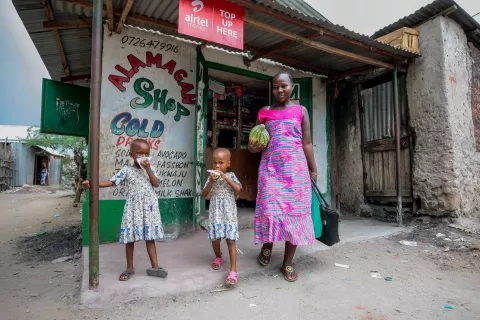
Although Akiro’s current living conditions remain tough and make it difficult for them to save money, she dreams of one day having her own kiosk to sell basic commodities. “This kiosk will help us provide for our family, have more than one meal a day and hopefully support the education of Jackson,” says Akiro, looking at her eldest son who hopes to go to medical school and become a doctor.
A small uplift in the main monthly cash transfer (which has not increased since 2011), as envisioned in the draft Social Protection Bill, would help her achieve this dream for her and her family.

Contributors: Sudhanshu Handa, Luke Harman, Charles Otieno & George Kinyanjui.
[1] 2021 Kenya Poverty Report, Based on the 2022 Kenya Continuous Household Survey.
[2] Consolidated Cash Transfer Programme Management Information System (MIS).
[3] Policy_GovBrief.pdf (fao.org)
[4] Government of Kenya's Cash Transfer Program Reduces the Risk of Sexual Debut among Young People.
[5] The economic Impact of CT-OVC Programme in Kenya, FAO, 2013.
[6] The local economy impacts of social cash transfers, FAO, 2016
[7] Egger et al, (2022), General Equilibrium Effects Of Cash Transfers: Experimental Evidence From Kenya, Econometrica, 90(6).