Cash transfers help children achieve their potential during COVID-19
Reducing poverty keeps children learning and prevents child marriage

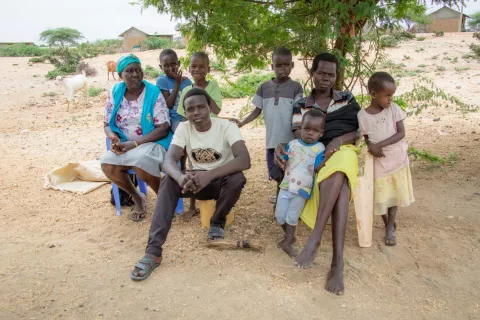
Sitting at the base of a thin-trunked acacia tree, 16-year-old Nashipae Nkanoni is concentrating on her schoolwork. Two neat plaits frame her face. Dry brush and brown soil stretch towards the hills of Kajiado County on the horizon. “During the pandemic, life here at home is not that good,” she says. “Sometimes we go to sleep hungry. When schools were closed, I felt disappointed because I had goals to achieve.”
Nashipae’s mother, Tereyian, stands outside the family’s home. It is made from corrugated iron and painted green and blue. A cockerel scratches in the dust. “Coronavirus ruined our businesses,” she adds. “We have nothing to offer our children because we can’t go to work in town. You are told that the time to conduct business is over because of the curfew. It has interfered with our livelihood and we lack food to give our children.”
The first case of COVID-19 in Kenya was recorded in March 2020. The country took swift action to contain its spread, including through curfews, travel restrictions and closure of markets. Although largely successful at containing the virus, these measures also had a devastating economic impact. Many families’ incomes were drastically reduced or disappeared. Those who were already the most vulnerable were among the worst affected.
Girls at risk
As families in Kajiado faced increased poverty, more began employing dangerous coping strategies and behaviours, which put the welfare of children and young people at risk.
“Kajiado County has unique vulnerabilities,” says Children Services Coordinator Samwel Manoti Masese. “There has been an upsurge in cases of female genital mutilation [FGM], early marriage, food insecurity and child pregnancy in the community.”
Many young girls risked becoming child brides because their families could no longer afford to keep them at home. In Kajiado, these girls often undergo FGM before being married. The practice was outlawed in Kenya in 2001 but continues in many areas. One in five women and girls between the ages of 15-49 has been cut. And almost a quarter of Kenyan girls are married by the age of 18.
“Girls are being married off so that their family can get money or cattle to survive,” says Tereyian, “But I have not thought of marrying off my daughters. I still live with them in my house, even though we are facing so many hardships.”

Despite Tereyian’s determination, Nashipae was still afraid that things might get so bad during the pandemic that her mother would have no other option. “I feared to be married off, or to be forced into harmful cultural practices like FGM,” she says.
As part of efforts to help reduce poverty linked to COVID-19, UNICEF has provided additional cash transfers for 12,500 families across Kenya, including 1,500 in Kajiado County. Under this initiative, each family receives a cash top up of 2,000 shillings bi-monthly (in addition to the existing 2,000 shillings per month), to help cushion them from the effects of poverty, including malnutrition. The programme is funded by the Governments of Finland, Italy, Sweden and the UK.
“In Kajiado County, the national safety net programme is expanding to provide a cash top up to Inua Jamii beneficiaries, to support on their income and provide economic strengthening,” says Susan Momanyi, Social Policy Specialist at UNICEF Kenya. “We are basically removing financial barriers – which is one of the strategies to reduce child marriage.”

Benefits of cash transfers
Multiple studies in different parts of the world have shown that providing cash transfers can improve food security and increase the number of people accessing health services, immunisations and school. In emergencies such as droughts, floods – and pandemics – cash transfers are considered one of the most effective ways to support families as parents are best placed to decide what their children need most. With a lump sum, they can purchase food, medicine, clothes and shelter as required.
In areas where a cash transfer programme is already in place to help tackle poverty, emergency assistance can be distributed more easily and effectively. Existing beneficiary lists can be used, as the most vulnerable families have already been identified.
Nashipae’s family is one of those receiving the monthly grant. Back inside their home, her mother Tereyian cuts vegetables into a yellow bowl, as she prepares the evening meal. “I have not received any help apart from the money given to us [under the cash transfer programme] that we use to buy food and upkeep for the family,” she explains.
Outside the house, Nashipae is taking a break from studying: laughing and playing with other children, spinning in a bright orange t shirt and red skirt. Now she feels that she has the opportunity to fulfil her potential.
“I want to be a doctor because I want to help my community and also to help the needy,” she explains. “I feel cared for and loved as my parents are supporting me in achieving my dream of being a doctor.”