Public-Private Partnerships for reliable oxygen supply
UNICEF is pioneering innovative Public–Private Partnerships (PPPs) together with partners to ensure oxygen systems don’t just get installed, but keep running efficiently and sustainably—so hospitals can keep children breathing and thriving.
The Challenge
Access to a continuous, high-quality source of medical oxygen saves lives. Children with pneumonia, newborns struggling to breathe, and patients undergoing surgery depend on it. Unfortunately, in many low- and middle-income countries (LMICs), reliable oxygen supply is a persistent challenge—even after major investments in equipment and health systems.
Oxygen systems in LMICs have historically struggled to operate sustainably, reflecting broader systemic challenges in these countries. Donated equipment, such as pressure swing adsorption (PSA) oxygen plants and oxygen concentrators, often break down or remain non-functional due to lack of skilled staff and limited government financing from Ministry of Health to operate and maintain them. As a result, hospitals are left with “equipment graveyards” instead of life-saving tools. Even when oxygen plants are running, long transport distances and poor road conditions disrupt oxygen cylinder delivery to the smaller health facilities that depend on them.

40% of medical devices
in resource-limited settings are out of service.

Only 10–30% of donated equipment
ever becomes operational

Fewer than 1 in 4 countries
in sub-Saharan Africa have a national policy on health technology management.
In the current context of reduced development funding, it’s more important than ever to make every investment count — to ensure it lasts and keeps saving lives. For this to happen, new approaches to procurement are needed that go beyond just one-time equipment provision, which often gives short-term support but leaves behind a burden of operation and maintenance.
The Solution
In response, UNICEF is pioneering Public–Private Partnership (PPP) models to strengthen health systems over time, by ensuring vital services like oxygen supply don’t stop after equipment is installed, but keep savings lives for years to come.
A PPP is a structured collaboration where public and private actors share responsibility, risk and reward to deliver public services. There exist different PPP models but principally, they are a mechanism that aligns incentives and expertise – maintaining public ownership and oversight while engaging private operators who are best placed to efficiently run and maintain equipment, under clear performance standards.
This approach allows governments and health facilities to focus on what they do best: delivering quality care, while allowing the private sector to do what they do best: deliver efficiently and reliably, motivated by commercial incentives. In combination, this allows the public sector to define what should be prioritized, ensuring equitable access while leveraging the efficiency that comes from commercial discipline.
The Impact
From oxygen to diagnostics and lab equipment, innovative business models and PPP are already improving care in low-resource settings. In Liberia and Uganda, UNICEF is currently implementing two types of PPP modalities that keep equipment running and life-saving oxygen flowing to patients - with one model focused on large-scale national production and the other on reaching primary health care facilities.

Out of 18 PSA oxygen plants in Liberia, an analysis found only 2 were functional and those were running at less than 50% capacity due to high operating costs, unreliable power, lack of skilled staff, and expensive spare parts. The Ministry of Health struggled to maintain them.
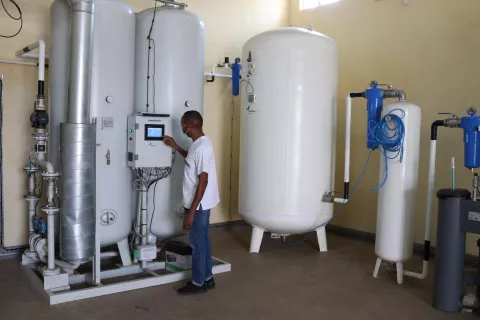
In response, UNICEF’s PPP model brings in approved Private Plant Operators (PPOs) to run 11 priority plants in a PPP modality. The model works by leasing each oxygen plant to a private operator, who sells oxygen back to the health facilities as a service. The facility pays the operators per litre of oxygen delivered via piping or cylinders, with payments subsidized through a donor-funded subsidy fund.
Each plant operates under a hub-and-spoke “milkman” model, where the plant serves as a central ‘hub’ that fills and delivers oxygen cylinders to smaller nearby facilities—the ‘spokes’—much like a milkman delivering bottles daily and collecting the empty ones.
This PPP model ensures:
- Transparent and competitive selection of operators through a Request for Proposal (RFP), focused on finding the most efficient operator from a mix of small local firms to pan-African or global companies competing to deliver the service most efficiently, with preference given to capable local businesses.
- Expert operation and maintenance of oxygen plants by operators motivated by commercial incentives to keep plants running efficiently, promote oxygen use and train healthcare professionals.
- Payments based on performance, where the operator is only compensated for oxygen actually delivered, creating a clear commercial incentive to maintain efficiency
- Equitable access, enabled by a donor-funded that allows hospitals to purchase oxygen at affordable rates in a Liberian context where commercial pricing would otherwise not be viable, without removing the operator’s commercial engagement.
- Integration with long-term national goals for oxygen supply and healthcare improvement by aligning the PPP with Liberia’s National Oxygen Roadmap and Strategic Plan.
I love it, and we shouldn’t just be doing it for oxygen, but for all complex assets, so that the government can focus on what the government should focus on; bringing health services to people.” - Deputy Minister of Health in Liberia


In Uganda, where pneumonia is the leading cause of death for children under five, access to oxygen at the primary health care (PHC) level is a challenge that persists due to remoteness of the facilities, weak supply chains, and limited access to training and repairs. The Lancet Commission on Medical Oxygen found that on any given day, 93% of PHC facilities in LMICs experience an oxygen stockout. This leaves children with hypoxemia—who rely on these facilities as their first point of care —without the treatment they urgently need.
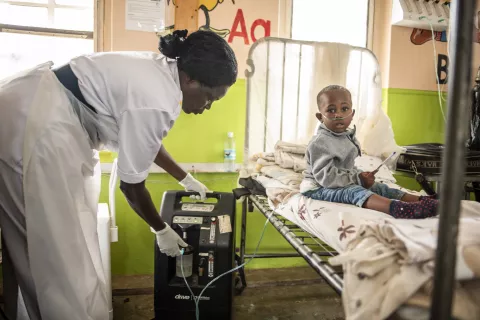
To address this, UNICEF introduced an innovative Oxygen-as-a-Service (O2aaS) model in Uganda - a PPP model designed to guarantee reliable bedside oxygen delivery at the PHC level. Instead of buying, installing and maintaining equipment themselves, hospitals and governments pay for a service that guarantees 24/7 oxygen availability, even during power outages. The rest is handled by private suppliers, who deliver a complete package of oxygen products and services, including:
- Equipment: On-site oxygen generation with backup systems, solar power for resilience, ward-level piping to deliver oxygen directly to the bedside, and pulse oximetry.
- Maintenance: Preventive and corrective maintenance, real-time remote equipment monitoring, a 24/7 hotline for troubleshooting support, and a rapid-response local team to provide repair and replacements.
- Capacity building: Clinical and biomedical engineering training, with ongoing mentorship to sustain the gains.
- System strengthening: Community engagement, data strengthening, improved quality of care, and alignment with national objectives and plans ensures a wide-ranging and sustainable impact.

Since its launch in early 2025 in Uganda, the O2aaS model has brought reliable oxygen to 35 PHC facilities in remote areas, maintaining nearly 100% uptime — meaning oxygen was available almost all the time. With oxygen now more reliably available on-site, risky referrals to distant hospitals have dropped by 60-100%, allowing more children in fragile condition to get the care they need without long, costly and dangerous journeys. In addition, dependence on expensive oxygen cylinders—tanks that had to be filled elsewhere and transported long distances—has dropped by over 50%, freeing up these scarce resources to be used for more critical patients in other wards.
“Oxygen is no longer uncertain, but a guarantee” - Juliet Awoko, a nurse at Kiryandongo General Hospital.
The experience in Liberia and Uganda shows that Public–Private Partnerships for oxygen are a new way of thinking about how health systems work, and how to make them stronger.
Sitting at the intersection of governments, donors, and the private sector, UNICEF is uniquely positioned to make these partnership models work. With its dual role as a procurement and development agency, UNICEF brings partners together across innovation, financing, and implementation to deliver sustainable results.
Building on our successful PPPs in diagnostics and cold-chain systems, UNICEF is now expanding this approach in oxygen, assistive technology, and biomedical engineering. As the development community seeks more sustainable ways to protect health investments, UNICEF’s experience shows that well-designed PPPs can turn equipment procurement into lasting, locally owned services aligned with national strategies.