The Philippines: Collaboration Toward DPG Knowledge and Capacity Building
Catalyzing the development and wider adoption of DPGs in health and financial inclusion
Progress toward every Sustainable Development Goal (SDG) hinges on the development of digital technologies and cooperation in their implementation. The Digital Public Goods Alliance (DPGA) works with partners and government entities in low- and middle-income countries to pilot new ways to change the existing power balance around digital solutions with digital public goods. Through these collaborations, the DPGA and UNICEF run pathfinding pilots to help define use cases, identify needs, inform adaptations, and enable policy frameworks.
UNICEF Philippines’ pathfinding pilot objectives are to 1) find ways that DPGs can benefit from and leverage existing technical country capacity to better existing Technology for Development (T4D) efforts that are both relevant to UNICEF programming and supported by UNICEF Philippines and the Government; and 2) establish a mechanism to transfer that capacity and knowledge to other sectors including education and climate change, including a wider range of government line agencies.
As part of this pilot, a local DPG landscape analysis was conducted to find out which DPGs are currently in use or being developed and what additional sectors they can serve. This included a landscape map, Local DPG Accelerator Toolkit, and a DPG Accelerator Lab Starter Toolkit. The considerations for this landscape analysis includes: I) using a fully minted DPG technology, ii) uses a technology that is nominated as a DPG, iii) a technology that could be a potential DPG.
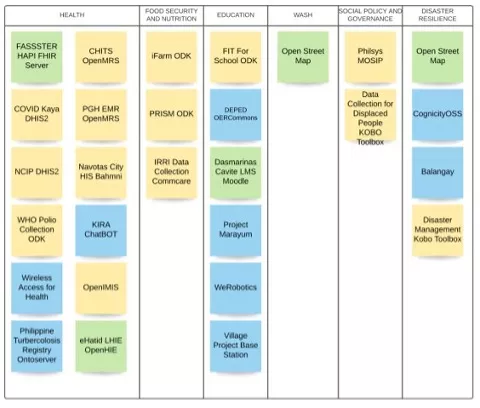
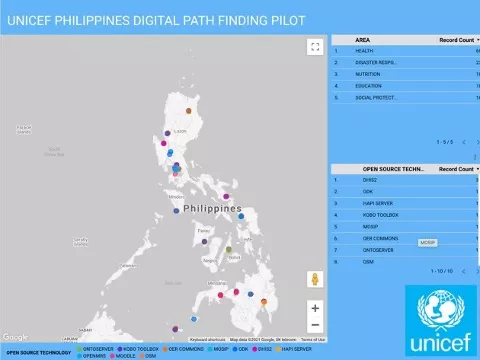
UNICEF Philippines has been collaborating with the Philippines Council for Industry, Energy, and Emerging Technology Research and Development division of the Department of Science and Technology, a national government agency, to raise awareness of the DPG Standard and the value of aligning digital solutions to it.
UNICEF Philippines' approach to the DPG Pathfinder pilot was the following:
- Search for Solutions – Look at solutions being piloted that could be "potential digital public goods" in spaces such as government projects, funded academic research and start-ups. UNICEF Philippines conducted a maturity assessment to determine areas where they could support these projects.
- Knowledge Building – Conducted regular capacity building activities to promote the use of DPGs, and created a Knowledge Hub for various knowledge materials. UNICEF Philippines successfully integrated a Digital Public Goods elective course at a University to introduce DPGs. This also included hosting webinars with universities and academia, particularly with institutions that have a focus on research.
- Program Support – Engage with UNICEF CO programs to promote the use of DPGs in program work, and review ToRs and documents to see how DPGs could be implemented within these documented programs.
The Philippines has an active innovation and startup community, which includes Project AEDES, a dengue data modelling prototype which was developed by CirroLytix with support from Philippines Department of Science and Technology, and was one of the first digital solutions engaged by UNICEF Philippines.
“We joined the 2019 NASA Space Apps Challenge as an entry point to the development sector, especially since the focus of the competition was the Sustainable Development Goals,” at the time, “dengue was an epidemic in the country, the worst it had been in the last five years."
The AEDES prototype is an automated information portal that correlates dengue cases and deaths with real-time data from climate, Google searches, and satellite maps. Further research and consultations with epidemiologists pointed to certain connections between weather patterns and Google searches to dengue cases, as well as to existing work around detecting stagnant water and mosquito habitats from space. Using this information, AEDES provides an advanced indicator of when dengue will emerge and potential hotspots that may arise. This portal can benefit public health and local government agencies by giving advance notice of dengue outbreaks which can help prioritize resources.
With an open content, open data, and open AI model license, the aim was to make it easier for a developer to access AEDES, use it, deploy it, and then replicate it in a very programmatic way. These resources and the learnings gained throughout the nomination process now also inform CirroLytix’s development and documentation of their other projects.
In May 2021, AEDES became a digital public good. The CirroLytix team hopes this can accelerate the development of technology that can save lives stricken by dengue by increasing their visibility to other dengue research initiatives and experts involved. Read more here.
Learnings and Challenges:
- Important to build communities of practice - Dissemination of DPG concepts to the general public are important. It takes time to build awareness and even adoption to DPGs. Therefore, including individuals such as government individuals, academic leaders are key to advocate and push for adoption of the DPG standard.
- Government is key – There are ongoing discussions with the Ministry of ICT, where there is capacity to support in the early stages, which doesn't align with the DPG framework (to meet maturity metrics), however, this government body are natural allies, along with startup partners, to onboarding more developers in the DPG Pathway.