Every woman deserves to reach her destination safely, and to remain in control if a journey turns threatening. In Nairobi, Kenya, an ordinary matatu or bus ride can change in seconds. An unwanted touch. A threatening comment. An unexpected turn.
A woman may need to record what happened, find trusted support or decide whether she wants to report it. SafeRide was built for that moment. Developed by Esheria Ventures, it gives a woman a private place to write down what happened, understand her options and choose what to do next. The main reporting steps continue to work when internet access is poor or unavailable.
The project began in 2025 after the team saw how difficult it can be to move between separate paperwork, offices and support services after an incident. SafeRide brings those first steps together on one phone while keeping each decision with the person who experienced the incident.
The team brings together law, artificial intelligence, product design, content and community partnerships. That mix matters: legal and safeguarding experience shapes the language and consent process, engineers design for unreliable connectivity, and community partners help ensure that support pathways reflect real needs.
Designed around choice, privacy and safety
SafeRide begins with a private incident draft. A user can describe what happened in her own words, add a time and general location, attach notes or media if she chooses, and return to the draft later. The app saves the draft on the phone so she can continue even if the network drops.
Creating a draft does not send it anywhere. At a separate review step, the user decides what happens next. She can keep the record private, prepare a structured report for her own review, or look at available support and referral options. Before anything leaves the phone, SafeRide explains what would be shared, with whom and why, and asks for confirmation.
A quick-exit button and calculator-style decoy screen offer additional discretion when privacy changes suddenly.
In future, and only after the necessary approvals, users may also be able to contribute broad, privacy-protected route information. This could help communities and transport partners identify repeated risk areas without collecting names, personal stories, media or exact journeys. Our wider vision is public transport where women and girls can travel with greater confidence and where support systems can respond to recurring risks.
The current testing pathway is for adults only. Any future work involving girls would require a separate, approved child-safeguarding approach.
Why the AI stays on the phone
SafeRide’s assistant is designed to work on the phone instead of sending a sensitive conversation to a remote AI service. After a one-time download on a compatible device, it can help explain information, organise a draft and suggest possible next steps even when connectivity is weak. The user reviews every suggestion and confirms every action.
The assistant is not a lawyer, doctor, counsellor or emergency responder. It is designed to offer clear, limited guidance and point users towards appropriate support.
To build it, we adapted a compact Google Gemma model using 1,904 fictional training conversations, half in English and half in Kiswahili. No real survivor accounts were used. The examples reinforce calm language, privacy, user choice and clear limits around legal, medical and emergency questions.
The work is still in progress. The AI has so far been tested on a high-memory Android phone. We are working to support a wider range of devices. We have published the app’s code and documentation on GitHub, and the fictional training data and model materials on Hugging Face. Publishing the work openly allows developers, language specialists and safety reviewers to examine it, question our assumptions and suggest improvements.
The public software has passed 630 automated tests, including 41 focused on safety and privacy.
Testing, iterating, scaling
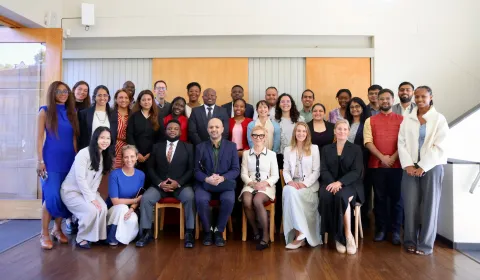
The UNICEF Femtech Ventures cohort has provided more than funding. Technical and privacy reviews, the Pretoria kick-off meeting, learning sessions and business mentoring have helped us connect each product milestone to a human question: can a woman understand her choices, trust the app and use it confidently during a real journey?
With this support, we trained and published the SafeRide model, added it to a signed Android preview, strengthened privacy and safeguarding controls, expanded testing and prepared a staged adult pilot with HURIA, a Kenyan human rights organisation.
Testing with participants will begin only after the agreed readiness, consent, referral, safeguarding and ethics requirements are complete. An earlier testing cycle produced 15 anonymised product findings. The team responded to every finding, and all nine high-priority fixes later passed technical checks.
That experience clarified what the next pilot must measure: whether the app is easy to use and understand, whether participants trust it, how it performs on their phones and whether follow-up support works as planned.
The pilot will also help us build a sustainable partnership model with women’s rights organisations, support providers and transport operators. Our aim is to grow through trusted services and responsible partnerships without turning sensitive personal information into a commercial product.