
Climate Partnership Results
Results of the ROK-UNICEF Climate Partnership
Overall Programme Target
Over 120,000 people, including 48,000 children, are expected to gain access to climate-smart social services and infrastructure across all five countries.
Results by Country
Climate Partnership Countries
Government and Partner Engagements
1. Strategic Partnership & Governance
- MoU on climate services (30 March 2026):
The National Weather Service, KOICA/Republic of Korea, and UNICEF signed an MoU to strengthen climate risk monitoring and early warning systems, supporting improved preparedness and protection of children and essential services. - Sub-national integration (April 2025):
Engagement with the Central Provincial Administration to align climate-resilient social service delivery within government systems.
2. Government Engagement & Coordination
- District administration meetings:
Ongoing coordination with local authorities to support programme implementation and delivery.
3. Technical Partnership
- National Weather Service collaboration:
Partnership focused on strengthening climate information systems and early warning services.
4. High-Level Engagement & Visibility
- MoU engagement (March 2026):
Government of Papua New Guinea, KOICA, and UNICEF jointly advanced national efforts on climate information and early warning systems. - Korean Ambassador visit (August 2025):
Visit to Kemabolo community to showcase a solar-powered water system and community-led management model.
5. Programme Implementation & Scale
- Programme launch and coordination (August 2025):
Initiative launched in Kemabolo (Rigo District), directly reaching 30,000 people, including 12,000 children, and improving access to health and education services for nearly 450,000 people nationwide.
UNICEF and the Climate Change and Development Authority (CCDA) co-hosted a multi-ministry workshop with Education, Health, and Meteorology to review progress and define next-phase priorities.
| Contribution | $6,745,000 |
| Targeted Population | 5 communities in Rigo District, Central Province: Boregaina, Kemabolo, Hula, Toule, Kokorogogo Directly reaching over 30,000 people, including 12,000 children |
| Summary | The PNG Country Office delivers climate-resilient WASH and solar power to schools and health centres in Rigo District. Core activities include community water systems, solar installations (36.5 kW PV with battery storage), community governance (Water Committees, user-pay model), health and teacher training, school nutrition programs, and policy support to integrate child-responsive climate adaptation into PNG's next NDC. An MoU with Central Province (April 2025) anchors delivery within government systems. |
| Key Achievements |
|
Government and Partner Engagements
1. Strategic Partnership & Programme Launch
- Climate Action for the Last Mile (March 2025):
UNICEF launched a US$6.2 million KOICA-funded programme (2025–2027) to strengthen climate resilience for children and young people. The event was led by the Office of the Vice Prime Minister and brought together KOICA, key government ministries, UN agencies, and civil society partners.
2. Infrastructure Development & Service Delivery
- Ground-breaking (23 October 2025):
Initiated solarization and climate-resilient WASH upgrades in Hera. - Handover ceremony (April 2026, Hera):
The Government of Timor-Leste, KOICA, and UNICEF marked the completion of integrated climate-smart infrastructure. A solar mini-grid and upgraded WASH facilities were handed over to the Government.
The system now powers the Hera Health Post, a nearby school, and a community centre, positioning Hera as a demonstration site for climate-smart social services.
| Contribution | $5,695,000 |
| Targeted Population | More than 30,000 children and families in Dili, Lautem, and Viqueque Accessing climate-smart social services across WASH, healthcare, nutrition, education, social protection, and child protection |
| Summary | The Timor-Leste Country Office delivers climate-resilient systems across multiple sectors, including WASH (Water Safety Plans, guideline development for water conservation, salinity monitoring ), Health (environmental health risk monitoring, indoor air-quality guidelines, clean-cooking stoves), Nutrition (schoo -based climate-smart nutrition education, provision of climate-resilient nutrition screening tools), Education (Grade 7 and 9 climate curriculum, teacher training, school greening), Social Protection (identification of 34,369 climate-vulnerable children through Bolsa da Mãe), Child Protection (mobile birth registration, parenting sessions), Infrastructure (solar system installation and WASH facility upgrades in schools, healthcare facilities, and community centers), and Climate Information Systems (community-based early warning). |
| Key Achievements |
|
Government and Partner Engagements
1. Strategic Partnership & Programme Launch
- Government of Korea contribution (March 2025):
A US$7 million investment announced to strengthen the Solomon Islands’ resilience to climate threats over a two-year period.
2. Government Engagement & Coordination
- Inter-ministerial workshop (August 2025):
UNICEF convened the Ministries of Climate, Education, and Health to review progress under the KOICA-supported programme and explore pathways to scale national climate resilience efforts.
| Contribution | $6,095,000 |
| Targeted Population | More than 200,000 people, including over 30,000 in East and West Ghoabata, Guadalcanal Province Gaining access to upgraded climate-smart social services and infrastructure |
| Summary | The Solomon Islands Field Office delivers climate-resilient systems in Guadalcanal Province across WASH (community-led sanitation, WASH-in-Schools), Health & Nutrition (climate-sensitive protocols, nutrition profiling in boarding schools), Education (School-Based Disaster & Climate Resilience Handbook rolled out to 6 schools), Child Protection (mobile birth registration, mental health support), Infrastructure (solar mini-grids for schools, stand-alone systems for clinics across 15 communities, 13 schools, 7 health facilities), Climate Information Systems (Multi-Hazard EWS Roadmap), and Policy (National Adaptation Plan, Loss & Damage Dialogue). Programme launched February 28, 2025. |
| Key Achievements |
|
Government and Partner Engagements
1. Government Engagement & Coordination
- KOICA M&E Mission (February 2026):
Joint field visits in Anjouan and Grande Comore with government partners, beneficiaries, UNICEF Comoros, and the Centre of Excellence for Climate Resilience. - Baseline and programme design (March–May 2026):
Work initiated to refine the Theory of Change, logframe, and indicator system for the programme, with national consultations planned in early May 2026.
2. Service Delivery & Handover Support
- Handover events (20 February 2026, Moroni):
- Radio equipment provided to the Ministry of Gender Promotion, Solidarity and Information to support listening circles
- Solar systems and ICT equipment handed over to the Ministry of National Education, benefiting 11 schools
3. Knowledge Exchange & Technical Partnerships
- K-eco technical exchange (April 2026):
Introduced Korean medical waste management practices and explored context-adapted solutions for Comoros and Zimbabwe, including phased approaches to waste reduction, recycling, improved landfilling, and future incineration readiness.
4. Community Engagement & Behaviour Change
- Teen Clubs (since March 2024):
UNICEF-supported clubs in Moheli engage adolescents in beach clean-ups and awareness campaigns on climate change, environmental protection, and adolescent well-being.
5. Regional Partnership Framework
- Government of Korea support:
Comoros is part of the Eastern and Southern Africa regional programme, supported by a US$10 million contribution to strengthen climate resilience for vulnerable children and communities.
| Contribution | $2,290,000.40 |
| Targeted Population | Direct beneficiaries: 10,000 people (40% children) Indirect beneficiaries: 100,000 |
| Summary | The KOICA-supported project in Comoros builds climate resilience for vulnerable children through integrated interventions across WASH, health, nutrition, education, social protection, and child protection. Core activities include climate-resilient water and sanitation systems, climate-sensitive disease surveillance, community-based nutrition monitoring, school solarization with climate curriculum integration, and climate-adapted cash transfers and child protection systems. Through data generation, policy advocacy, and youth engagement, the project creates sustainable systems that safeguard children against climate vulnerabilities. |
| Key Achievements |
|
Government and Partner Engagements
1. Governance & Coordination
- 3rd Project Steering Committee (29 April 2026): Convened government ministries, district coordinators, implementing partners, UNICEF, and the Korean Ambassador as Guest of Honour.
- Regular coordination mechanisms:
- 6 Joint Monitoring Visits (WASH)
- District monthly meetings
- 2 quarterly review meetings
- Ongoing local-level monitoring
2. Programme Monitoring & Implementation
- Nutrition (Mar–Apr 2026):
Monitoring visits in Beitbridge and Harare confirmed Care Group, gardening, and food security/livelihood activities are on track. - Education & Youth (Mar–Apr 2026):
3 monitoring visits covering school environment clubs, youth advocacy training (Chipinge), and youth innovation (Mangwe).
3. Evidence & Planning
- Baseline consultations (29–30 April 2026):
Conducted with PSC members and multi-sector technical stakeholders (health, WASH, education, nutrition, child protection, social protection).
4. Strategic Partnerships with Korea
- K-water collaboration:
- Initial MoU signed: 25 February 2026
- Final MoU signed by Government: 16 April 2026
Focus on integrated water resource management.
- K-eco technical exchange (8 April 2026):
Shared Korea’s expertise in medical waste management and explored context-adapted approaches for Zimbabwe and Comoros.
5. Programme Launch & Scale
- Climate Action for the Last Mile (March 2025):
US$5M initiative launched by Government, UNICEF, and KOICA.- Direct beneficiaries: 30,000 (40% youth)
- Total reach: 1 million+ people
6. Results Snapshot
- WASH (2024):
- 574,060 people reached
- 156 schools supported with basic water services
| Contribution | $4,019,295.10 |
| Targeted Population | Direct beneficiaries: 20,000 people (40% children) Indirect beneficiaries: 200,000 |
| Summary | The KOICA-supported project in Zimbabwe enhances climate resilience for vulnerable children and communities through integrated interventions across WASH, health, nutrition, education, social protection, and child protection. Core activities include climate-smart infrastructure (solar-powered water systems, rehabilitated boreholes, improved school and clinic sanitation), youth empowerment through climate education and innovation hubs, climate-sensitive health and nutrition surveillance, and strengthened child protection in emergencies. Through policy advocacy, data generation, and inclusive planning, the project reduces climate vulnerabilities and ensures sustainable, child-centered development. |
| Key Achievements |
|
UNICEF RISE: Water and Toilet (2026)
Papua New Guinea
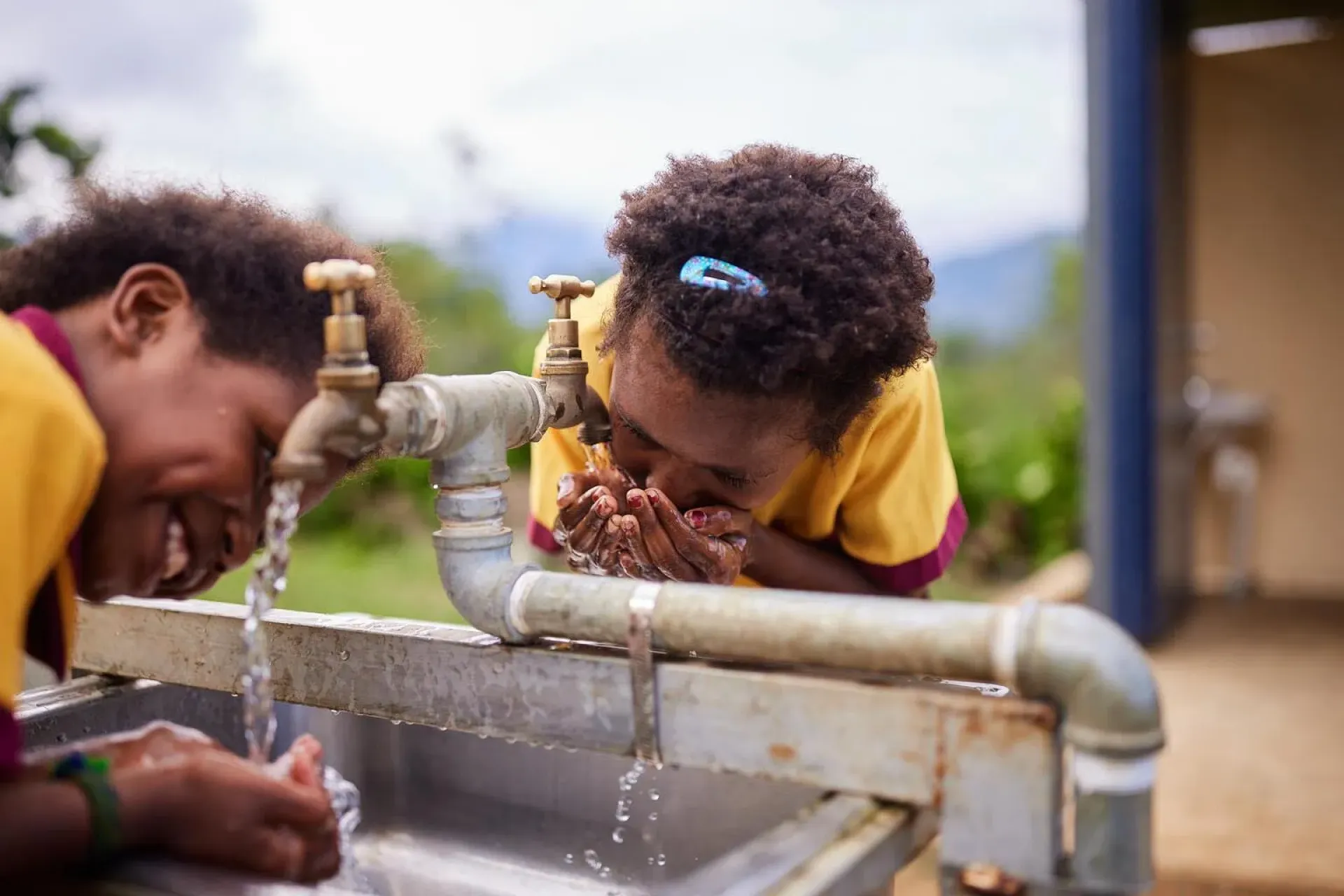
At Muya Primary School in Huon Gulf, unreliable water meant students, especially girls, often missed class or went home after half a day. With support from UNICEF and KOICA, a 9,000-litre tank with a solar-powered water system now provides reliable, safe water, with taps near the classrooms for handwashing.
UNICEF RISE: Community-Led Total Sanitation (2026)
Papua New Guinea
In flood-prone Nasuapum, heavy rain once washed waste from toilets into the community and caused frequent illness. Through community-led total sanitation, residents learned about hygiene and built climate-resilient toilets elevated above floodwaters, along with tippy-taps for handwashing.
UNICEF RISE: Teaching Conflict Resolution in Schools (2026)
Papua New Guinea
Generational tensions between clans have affected how children behave and interact at school. At Muya Primary School, teachers trained in conflict resolution and behaviour management now talk with misbehaving students instead of sending them home, recognising that every child has a right to education.
UNICEF RISE: Communities with Child Protection (2026)
Papua New Guinea
In Timini, positive parenting sessions run in partnership with a local church give parents and caregivers the tools to stay level-headed in trying times. For more vulnerable children in Zenag, child-friendly spaces after school offer psychological support, play and learning in a safe setting.
The World Environment Day (2026)
Eastern & Southern Africa
This World Environment Day, we celebrate progress in building climate-resilient. communities, looking at how safe water is improving daily life for children and families in Kuwadzana, Zimbabwe.
Climate-resilient water systems are now serving more than 2,500 students and 130,000 health clinic patients in the community.
Clean Water Close to Home (2026)
Timor-Leste
In the remote village of Maulau, Timor-Leste, accessing clean water once meant walking 1.5 hours across steep, muddy terrain.
Today, a UNICEF-supported, climate-resilient water system has transformed daily life. Clean, safe water is now just minutes from home.
Note: The partnership was signed in May 2024, and country-level launches occurred progressively through 2024-2025. As this is a three-year programme (2024-2027), full results are still being implemented across all five countries.