Together, we are empowering adolescent girls in Ghana
Eight stories of amazing and resilient young girls who are overcoming obstacles with the right information and support from UNICEF and partners
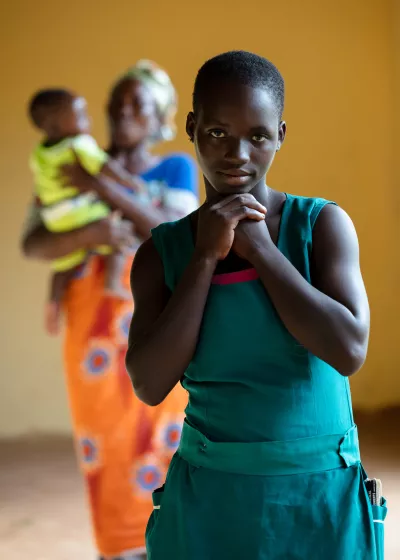
Peace, 16, wakes up twice at dawn to breastfeed her 6-month-old baby. Before she had her child, waking up at dawn meant revising her notes for school. Now she barely has time to catch up or read ahead of schoolwork. Even though it’s difficult to manage school and her baby, she is determined to get an education.
As one of the brightest students in Katejeli Junior High School, Peace won the admiration of her peers, teachers and her headmaster. “I am very intelligent and do well in class, so the teachers like me a lot. My favorite subjects were mathematics and social studies.” When I got pregnant, my parents would not allow me to stay in school. They made me stay at home until I had my baby."
Peace almost gave up the idea of returning to school but through the relentless encouragement of her teachers and sister in law, she re-enrolled. To make this possible, Peace drops off the baby with her brother’s wife before she gets to school at 6:30 am. During the 9:30 am and 12:30 pm breaks, Peace will dash off to breastfeed her baby.
“I dream of becoming a midwife. I want to be there for the young mothers and their babies during childbirth. I feel they need someone at that point in their lives to assure them that their lives are not over. When they see how I overcame my situation to achieve my dreams, they will be inspired.”
“I’m so much more confident now because I have learnt about reproductive health, personal and menstrual hygiene and self-confidence. I am also very grateful for the help in facilitating my re-entry into school."
I thought my life was over. I thought my education was over. Now I have a second chance.”
Peace, 16.
Katejeli, Northern Region - Ghana.
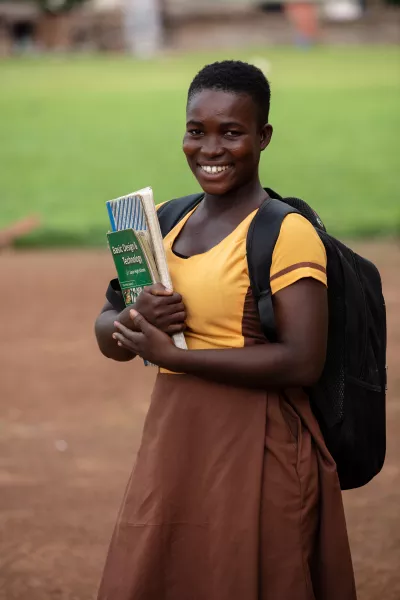
“My mother could not support my education anymore because it was becoming increasingly expensive and she also could not foresee being able to finance my senior high school education.” Jennifer’s mother advised her to travel to Accra to find work like other young girls in the community. Without any money to travel at the time, she baked pies for sale and saved GHS 60 ($11) to travel to Accra.
In Accra, Jennifer made GHS 12 ($2) a day working at a local restaurant. She could only save less than half of what she earned because she had to feed herself and pay to use the bathroom and do her laundry. She shared a bedroom shelter with five other girls, she had to pay GHS 15 weekly for rent and a little extra for electricity.
A few months later, she fell ill and spent all her savings at the health centre. With nothing left, her friends had to contribute towards her transportation to return home. Her parents were disappointed she had returned without any savings and her mother advised her to go back and try again.
The second time, she travelled to Sehwi Debiso in the Western Region for a similar restaurant job which also did not work out. Then she headed to Kumasi where she lived with an aunt’s friend, a man who promised to help her find work. With no work and becoming dependent on him for a while, he started demanding sex, but she refused. He sent her packing but with nowhere to go.
After trying her luck with a galamsey (illegal mining) job that ended in another serious illness, Jennifer decided to return home making a vow not travel out for menial jobs. She missed school and needed a way to get back in to pursue her dreams.
"Mr. Peter, one of the teachers from the community, announced the introduction of the Safe Space for Girls’ program and encouraged young girls between the ages of 10 and 19 years to apply. I signed up and started attending the sessions which have been a life-changing experience for me.”
I got the opportunity to re-enroll in school through the program even though my mother fought strongly against it initially. “Girls should be encouraged to remain in school. From my experience, it is dangerous for young girls to travel by themselves to big cities to look for work.”
Jennifer is grateful for the girls’ group sessions because it has taught her about reproductive health and Sexually Transmitted Diseases (STDs).
She is ready to focus on her education and aspires to study geography in high school.
Jennifer, 18.
Bankamba, Northern Region - Ghana.
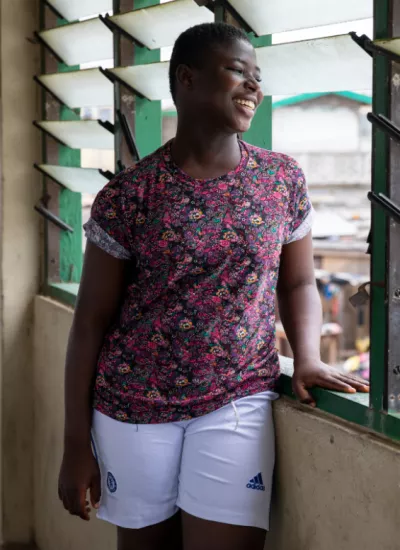
As the seventh born out of eight children, Akua experienced parental neglect from her mother whom she lived with in Elmina. It is quite a common occurrence for single mothers within the Elmina fishing communities to let their children fend for themselves due to poverty. Akua's siblings are each from different fathers and her father lives and works in another town called Abandze, a town 34km away from Elmina.
With not much to do as a young girl, Akua would leave the house in the morning with her friend who was being cared for by a boyfriend. Akua’s friend shared her meals and money with her and this led her to look for a boyfriend too. Young boys in the ‘ghettos' worked with the fishermen at the beach to earn a living aside the peddling of hard drugs and engaging in illegal activities.
“I dropped out of school because my family couldn’t afford it anymore and I started a relationship with my boyfriend who was a ‘ghetto boy’. In the ghetto, I was idle all day because my boyfriend would go to work in the morning with his young assistant with whom we lived together in a single room. He would give me some money for food and I would stay there till he returned. I was 15 years old by then. We would smoke Indian hemp and have sex. I wasn't taking care of myself and I hardly took a shower. I got sick eventually. I grew very lean. I would not advise anyone to go to the ghetto because it is not safe. The most traumatic experience that happened to me was very violent and it nearly cost me my life”.
Akua recounts her life just a year ago in the ghetto in disgust and anger. She raises her shirt to reveal a scar on her back, an incident she admits made her leave the ghetto. “Whenever there is a fight in the ghetto, it does not get settled until someone bleeds.” Akua was trying to break up a fight when she got cut on her back with a knife. She was rushed to the hospital for treatment and went back to her mother and family.
With an initial intent to revenge the assault on her after she healed, Akua changed her mind when she joined a community girls’ group—Promoting Adolescent Girls' Safe Spaces— that mentored and provided guidance for adolescent girls. “Joining this group has helped changed my behaviour and I now have an appreciation for my prospects in life. I have learned a lot about personal hygiene, how to be respectful and also how to take care of myself during menstruation.”
Akua has re-enrolled in school and enjoying her science classes. She is in the first year of junior high school and is very optimistic about writing the junior high final examinations.
Akua, 17.
Elmina, Central Region - Ghana
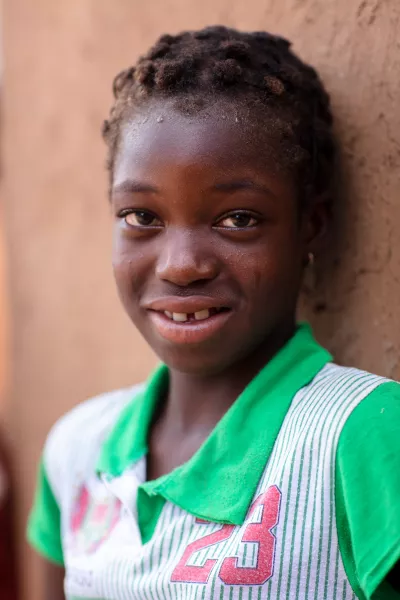
Salmu, 11, sits with her father as he receives guests under a tree outside their compound. She steals glances at the faces of the strangers as they talk about her. One can tell that Salmu is shy but she very comfortable with her father. The women in the house have all gone out to the farm to harvest. Salmu would have been with them but she is home now because her father is working out an opportunity to enroll her into a special needs school. Like other communities in Tolon, Northern Region, girls usually perform chores at home and go to the farm while boys are encouraged to pursue formal education.
Salmu is hearing-impaired. She has never been to school all her life. Salmu’s father has taken a special interest in his daughter to ensure that he does everything in his power to give her a fulfilled life.
After seeking traditional and religious solutions to her disability, Salmu’s parents decided to focus on enrolling her in a special needs school.
Salmu started joining the UNICEF-supported girls group sessions which were held in her community, even though does not hear or understand anything that was being discussed. However, her confidence level has increased as she interacts more with the girls in the community during group sessions. They try to explain what is discussed with signs and drawings. Her discomfort with being with strangers has also dwindled. The UNICEF- supported NGO that organizes the group sessions has assisted Salmu’s father has to make arrangements for his daughter to enroll in a special school. They have also helped in making further health checks for Salmu in Tamale.
Salmu’s father held the position that it was a risky investment to finance the education of the girl-child. But Salmu’s situation has made him reconsider this stance. “I find it difficult to take care of my family as a man with all my senses functioning. How is my daughter going to take care of herself when I am no more? I want to give up everything I have to ensure that she gets the best education, so she can be independent.”
Salmu Alhassan, 11.
Tolon, Northern Region - Ghana.
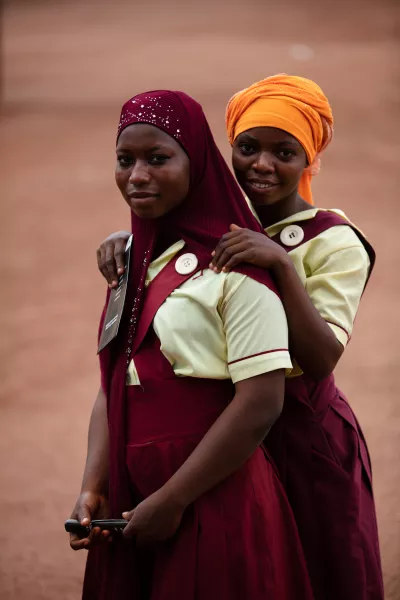
Shaibu Adamu, 19, never had the opportunity of formal education. Like most young girls in her community, she tried earning a living for herself and family by travelling down south to the capital of Ghana, Accra, to work as a head porter — kakayei. Over time she saved enough to get practical training in dressmaking.
Today, Shaibu is proud to be a member of the Ghana National Tailors and Dressmakers Association (GNTDA).
The Girls’ Iron-Folate Tablet Supplementation (GIFTS) Programme, a public health intervention to help prevent anemia in adolescent girls, was introduced to the association in April 2018. To target adolescent girls out of school, the Tamale Central Hospital has partnered with GNTDA to administer the Iron and Folic Acid supplementation tablets to young girls who are part of the over 800 members it has.
On Wednesdays, senior apprentices of the various dressmaking shops across the zones give the tablets to their adolescent colleagues. For the out-of-school programme, female business owners also take the tablets to reassure the apprentices that the tablets are safe and good for their health.
Shaibu is happy learning from her boss. She takes the tablets every Wednesday and she believes the tablets help boost her health and keep her active and strong for work. She has is learning how to combine fabrics to make beautiful dresses. Ever since she started making dresses, her favorite hobby now is to dress up.
Shaibu, 19.
Tamale, Northern Region - Ghana.
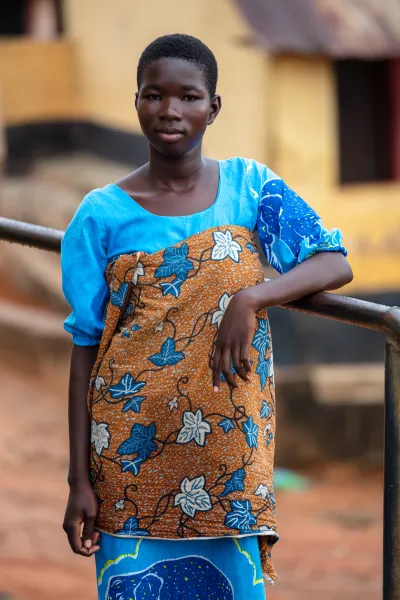
Christabel was only 11 years old when a 15-year-old neighbor took interest in her. He would give her money from time to time. One day the young boy proposed to her, but she refused, insisting that her education was more important to her.
She later agreed to be his girlfriend after his increasing persistence. One day he invited Christabel over to his place. “I went over to his place to borrow a text book and to visit him. I helped myself to a drink he was having when I got to his place. I fell into a deep sleep after taking a few sips and returned home later in the day when I woke up. Four months later I discovered I was pregnant, and he confessed to forcing himself on me the last time I visited him."
"I felt betrayed and hurt that he could do that to me. I wanted to abort the pregnancy, so I can continue to be in school, but I was too scared. I feared I could lose my life. I was only 13 years old at the time."
"What really breaks my heart now is that the boy has not been made to pay for what he did to me. The families have tried to settle the matter but I am not happy with where the resolution stands now. I am grateful for the efforts my mother is making to ensure I have a normal life. When she heard the announcement for young girls to register for the Safe Space for Girls’ program, she pressured me to sign up."
"My baby is 5 months old and through the Safe Space for Girls' Program, young girls in situations like mine are finding the courage to redefine their lives. I want to become a doctor, or a nurse and I am looking forward to going back to school to pursue that dream. For now, I am learning different skills. Over the past months, I have learned how to make reusable sanitary pads and fancy women’s slippers through the group."
Christabel, 15.
Kissi, Central Region - Ghana.
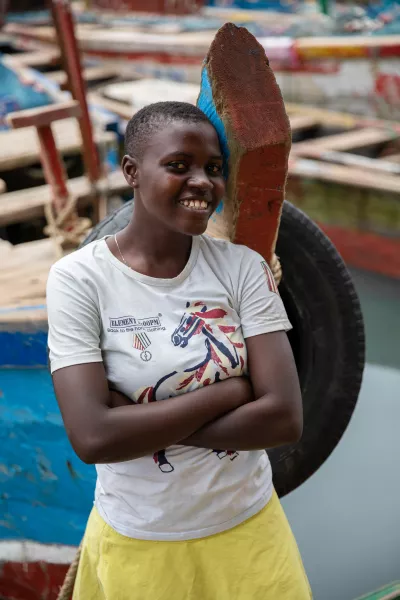
"I grew up with my mother and three older siblings here in Elmina. My mother was a fishmonger who took very good care of us even though she had little. We attended school and there was food at home.
However, my mother suffered a stroke back in 2016. I was preparing to write my final exams. I had to drop out of school because mother could not provide any more for my education. I stayed home to take care of her and also found work at the sea side to help support our upkeep. I helped the fishermen mend their nets when they returned from sea. The work I found was considered a man’s job, but I had to do it because I made as much as GHS 15 - GHS 20 in a day.
Surrounded by men, I soon found safety and comfort in a love relationship with a young man who worked the canoes for his master. I still don’t know his age, but he is definitely some years older than I am. This was the first time I was in a relationship and I got myself into it because he promised to take care of me and protect me.
I did not know anything about sex and the implications should I get pregnant or contract a venereal disease. I got pregnant after a few months of dating. I was scared of the embarrassment I had brought upon my family and I was not sure how I was going to cater for the child. My mother was disappointed. She cried. My uncle however suggested I keep the baby as the family will support me in raising the child.
My baby boy is 5 months old now and he is doing great. I want to be a news reporter when I complete my education.
Joining the Safe Space for Girls’ program here has motivated me to pick up my life and get back into school. I want to write the final exams and go to high school. I am going to work harder now that I have to take care of my baby as well.
This program has taught me so many things I didn’t know before and I am taking my education seriously now. Coming here and interacting with the other girls is inspiring. I want to be successful and I know it takes hard work."
Esther, 18.
Elmina, Central Region - Ghana.
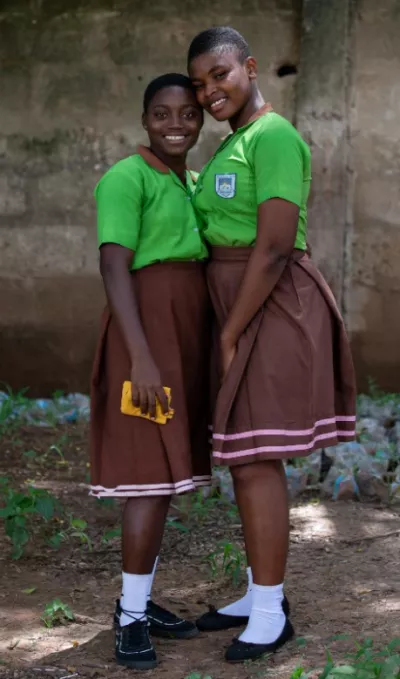
Rebecca, 18, acknowledges that the Iron Folate tablets helps her to regain blood when she goes through her menstrual cycle. She has also noticed that the tablets have increased her appetite, causing her to eat more. “Whenever I take the tablets, I begin to eat a lot because I get hungry at shorter intervals. This academic term, I brought more gari to help me cope.” - she says with a laugh.
Fatima Awal, 17, is happy to be in school. Today, for instance, she paid attention to a lesson on Government Policies and Pressure Groups. She attributes her improved attentiveness in class to the Iron and Folic Acid (IFA) supplementation tablets she takes. “Today we learned about the role of pressure groups in governance. I learned that these groups influence policy making and push government officials to do the right thing. I enjoyed the class.”
With the Girls' Iron-Folate Supplementation (GIFTS) initiative, anemia has been reduced by more than 26% per cent and adolescent girls are more attentive and active in class.
Fatima, 17 & Rebecca, 18.
Savelugu, Northern Region - Ghana.
1,000,000 girls have been empowered in Ghana with support from Global Affairs Canada, the Korea International Cooperation Agency (KOICA) and the UNFPA-UNICEF Global Programme to Accelerate Action to End Child Marriage.
These programmes are also supported by local partners - the Government of Ghana, The Ghana Police Service, International Needs, NORSAAC and Savanna Signatures.
To find our more about our donor partners, click on the links below.