“Without help, my babies would probably have died.”
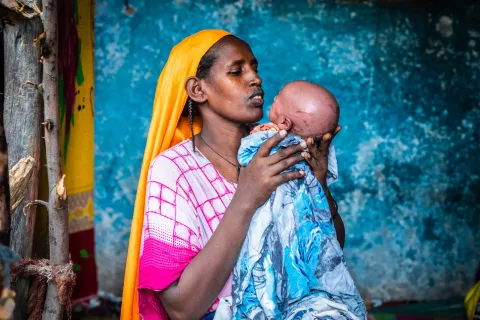
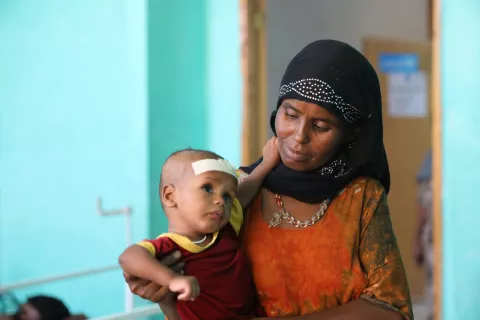
A mother treats her malnourished twins at a UNICEF-supported health post in one of the Dassenech (South Omo) Internally Displaced People (IDP) camp.

07 June 2022
Loyna Ares (35) is a mother of twin boys (7 months) and five more children. A few months ago, her life was turned upside down when her village was consecutively affected by drought and flood.
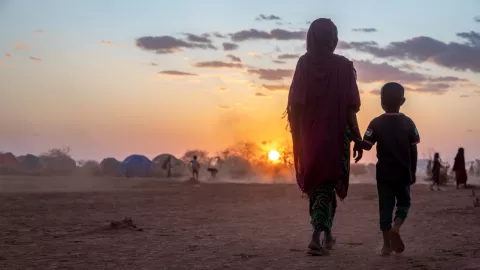
“We lost all our cattle and our farm,” says Loyna. “We had nothing to eat, so we had to move to the nearest IDP camp at Lomosia kebele (sub-district) to survive. I was very worried about my twin babies because they look sick and very weak. I couldn’t breastfeed them properly as I was not eating enough myself.”
For the past several months, the South Omo zone located in the Southern Nations, Nationalities, and Peoples' (SNNP) region in southern Ethiopia is severely affected by dangerous floods following unimaginable droughts, leaving families completely deprived and on their own.
“I suspected that my twins were malnourished,” explains Loyna “but I was unable to cross the river because of the flooding. Kidist [the health Extension worker in charge of the screening] found us at my Sorghum farm. She did a screening and found that my babies were severely malnourished. Without help, my babies would probably have died.”
“I suspected that my twins were malnourished,”

The ‘Find and Treat’ campaign has been launched by UNICEF in collaboration with the government to measure all available children (0‐59 months) through house-to-house screening using Mid-Upper Arm Circumference (MUAC) tapes. Its primary purpose is to identify and treat children suffering from severe acute malnutrition.
“If the child's upper arm circumference is less than 11.5 cm and there are no medical complications and has a good appetite, he or she will be admitted to outpatient treatment and receive ready-to-use therapeutic food (plumply nut),” explains Israel Alemayehu, UNICEF Nutrition Officer. “Otherwise, if the child has no appetite or if there are medical complications, the child will be admitted to the closest inpatient facility.”
As of today, UNICEF has already screened over 420.000 children for severe acute malnutrition across the four drought-affected regions: Afar, Oromia, Somali and SNNP regions.

“Why should I go back for more suffering?”
"When she discovered that I was weak and my babies were severely malnourished, Kidist gave them Plumpy Nut and Vitamin A,” remembers Loyna. “Now my babies are in better condition.”
Before they moved from their village, Loyna and her family had a farm and several cattle. She used to get enough cereals, milk, and meat for her children. A future threatened by climate change: “Now that I have lost my livestock because of the drought, and my Sorghum field due to the flood, I am not planning to go back. Why should I go back for more suffering? I can only rely on government, organizations, and NGOs help,” concludes Loyna.

In Ethiopia, nearly 9.9 million people, including 4.5 million children, are currently affected by the drought across the four regions mentioned above. Amongst them, an estimated 1.5 million are malnourished children. Their treatment is made possible by the generous contribution of USAID, particularly through the provision of ready-to-use therapeutic food (RUTF).