

Investing in WASH Progress for Children in Ethiopia
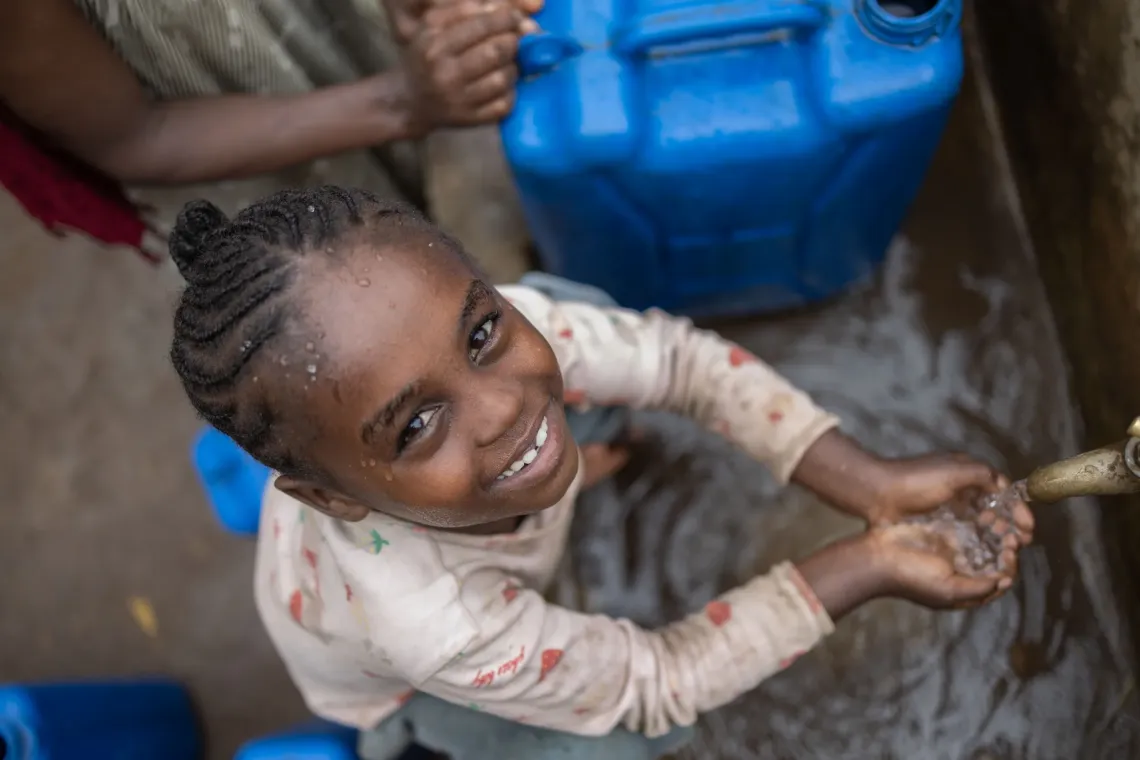
For every child, clean water!

For every child, clean water!
Ethiopia has made measurable progress in expanding water, sanitation and hygiene services, but the remaining need is urgent. With more than 73 million children under 18, including around 21 million children under five, WASH investment is one of the most direct ways to protect child survival, nutrition, dignity and learning. Current service gaps remain significant: basic water supply coverage is estimated at 49.6 per cent, basic sanitation at 8.9 per cent and basic hygiene at 4.8 per cent. These gaps are increasingly climate-sensitive. The Climate Landscape Analysis for Children in Ethiopia highlights that an estimated 83 per cent of children are exposed to heatwaves, nearly one quarter are exposed to water scarcity, and unsafe water, sanitation and hygiene are associated with an estimated mortality rate of 40.7 per 100,000 population.
Investment imperative: Accelerated and sustained WASH investment can deliver measurable benefits for children and climate resilience when each intervention is linked to a clear results pathway. Climate-resilient water systems reduce water scarcity and service disruption; sanitation and hygiene investments reduce disease risks after floods and outbreaks; WASH in schools and health facilities protects learning, dignity and continuity of care; stronger systems improve readiness and accountability; and renewable energy solutions for pumping, treatment and service delivery reduce operating costs and the carbon footprint of WASH services.
Challenges
- More than 73 million children under 18 in Ethiopia depend on resilient systems for safe water, sanitation and hygiene.
- Around 21 million children under five are especially vulnerable to disease, undernutrition and climate-related shocks.
- Basic water supply coverage is estimated at 49.6 per cent; basic sanitation and hygiene coverage remain at 8.9 per cent and 4.8 per cent respectively.
- An estimated 83 per cent of children are exposed to heatwaves, and nearly one quarter are exposed to water scarcity.
- Strategic WASH investment can reduce disease risks, protect learning and dignity, lower repeated humanitarian costs and strengthen climate resilience.
Solutions
Recent evidence, including the Ethiopia Demographic and Health Survey 2024–25 and UNICEF Ethiopia WASH programme documents, points to important gains in reducing open defecation and expanding basic water supply. However, progress remains uneven. Sanitation and hygiene coverage are still far below the level required to protect every child, while climate shocks, population growth, urbanization and recurrent emergencies continue to stretch fragile systems.
For children and communities, these gaps are experienced in practical ways: unsafe water increases disease risks, inadequate sanitation affects dignity and safety, poor hygiene fuels outbreaks, and unreliable services disrupt schooling, health care and household resilience. Women and girls are often most affected when water collection takes more time or when schools and health facilities lack safe, inclusive WASH services.
- Water: Basic water supply coverage is estimated at 49.6 per cent, underscoring the need for sustained investment in safe and climate-resilient systems.
- Sanitation: Basic sanitation coverage remains low at 8.9 per cent, increasing exposure to disease and environmental contamination.
- Hygiene: Basic hygiene coverage is estimated at 4.8 per cent, highlighting the need for stronger behaviour change, facilities and supplies.
- Equity: Rural communities, displaced populations, water-insecure areas, women, adolescent girls and children remain among the groups most affected by service gaps.
- Health impact: Unsafe water, poor sanitation and inadequate hygiene continue to contribute to communicable diseases, undernutrition and preventable child mortality.
UNICEF’s Value Proposition
UNICEF brings a unique combination of government partnership, convening power, technical expertise, field presence, humanitarian capacity and trusted relationships with communities and implementing partners. This enables UNICEF to support scalable WASH solutions that are nationally aligned, locally grounded and focused on children and the most vulnerable populations.
UNICEF’s comparative advantage lies in its ability to bridge humanitarian response and long-term systems strengthening. Through the One WASH National Programme, INE WASH Phase II / Phase II Town Water Utilities documents, the TSEDU Social and Behaviour Change Strategy and related systems-strengthening materials, UNICEF supports climate-resilient water systems, utility strengthening, sanitation market development, hygiene promotion, menstrual health and hygiene, emergency preparedness, evidence generation, monitoring, sector coordination and the scaling of proven approaches.
From Emergency Response to Resilient Services
In emergencies, UNICEF helps reduce immediate public health risks through rapid WASH coordination, technical support to partners, emergency water supply, sanitation and hygiene interventions, and preparedness for recurrent shocks such as drought, flooding, displacement and cholera outbreaks.
Beyond emergency response, UNICEF promotes durable, shock-responsive and climate-resilient WASH systems. This includes strengthening water utilities, supporting multi-village water supply schemes in water-insecure areas, improving operation and maintenance systems, and building partner and institutional capacity to sustain services over time.
Investments in climate-resilient WASH generate a double dividend. They protect children now by reducing exposure to unsafe water, poor sanitation, hygiene-related disease, school disruption and protection risks, while strengthening communities and service providers to withstand future climate shocks. In water-insecure and disaster-prone areas, resilient systems can reduce repeated emergency costs, sustain services during droughts and floods, and preserve development gains for the most vulnerable children.
Investment Priorities and Expected Climate Benefits
The following priorities summarize the WASH Section’s core focus areas for accelerating SDG 6 progress, protecting children, strengthening climate resilience and reducing repeated humanitarian need.
- Climate-resilient water services: Invest in safely managed, drought- and flood-resilient water systems, including multi-village schemes, protected sources, storage, water safety planning and resilient operation and maintenance. Expected climate benefit: reduced water scarcity impacts, fewer service interruptions during droughts and floods, and more reliable access to safe water for children and families.
- Renewable energy for WASH services: Expand solar and other renewable energy solutions for water pumping, treatment, monitoring and utility operations, particularly in off-grid and water-insecure areas. Expected climate benefit: lower lifecycle operating costs, reduced dependence on diesel fuel, lower greenhouse gas emissions and a smaller carbon footprint for WASH service delivery.
- Sanitation transformation: Expand safely managed sanitation, sanitation markets, fecal sludge management and sustained reduction of open defecation. Expected climate benefit: reduced contamination of water sources and living environments during floods, lower disease transmission risks and stronger protection of children’s health, nutrition and dignity.
- Hygiene and behaviour change: Scale evidence-based hygiene promotion, household handwashing facilities and institutional hygiene standards. Expected climate benefit: reduced outbreak risks during climate-related shocks, especially cholera, diarrhoeal disease and other waterborne or hygiene-related infections.
- WASH in schools and health facilities: Strengthen inclusive, gender-responsive and climate-resilient WASH facilities in schools and health-care settings, including menstrual health and hygiene. Expected climate benefit: safer learning and care environments, improved continuity of education and health services during shocks, and stronger protection for girls, children with disabilities and vulnerable children.
- Systems, data and accountability: Strengthen sector coordination, utility performance, climate-risk-informed planning, monitoring, financing and public accountability. Expected climate benefit: better-targeted investments, measurable results, improved preparedness and more sustainable services under increasing climate stress.
- Humanitarian-development resilience: Link emergency WASH preparedness with durable infrastructure and local capacity strengthening in high-risk areas. Expected climate benefit: reduced repeated humanitarian need, faster response to droughts, floods and outbreaks, and stronger protection of development gains for children.
Resources
The bibliography below consolidates the current and previous materials cited or referenced in this brief. Current references are listed first because they provide the main evidence base for the updated progress narrative.
Current references
- Central Statistical Agency, Ethiopian Public Health Institute, and ICF. Ethiopia Demographic and Health Survey 2024–25. Addis Ababa, Ethiopia.
- UNICEF Ethiopia. Climate Landscape Analysis for Children in Ethiopia: Baseline Assessment—Climate, Energy, Environment, Disaster and Children. Addis Ababa, Ethiopia.
- UNICEF Ethiopia. TSEDU Social and Behaviour Change Strategy. Addis Ababa, Ethiopia.
- UNICEF Ethiopia. INE WASH Phase II / Phase II Town Water Utilities Reference Documents. Addis Ababa, Ethiopia.
- UNICEF Ethiopia. ECO CEE WASH Programme Overview for the Global Director. Addis Ababa, Ethiopia.
- UNICEF Ethiopia. Approach Paper on Water Utility Systems and Capacity Strengthening in Ethiopia. Addis Ababa, Ethiopia.
- UNICEF Ethiopia. Resilient Sanitation Markets for TSEDU Ethiopia 2030. Addis Ababa, Ethiopia.
Previous reference materials
- UNICEF Ethiopia. Rural WASH Sustainability Checks and Related Learning Products. Addis Ababa, Ethiopia.
- UNICEF Ethiopia. Baby and Mother WASH Documentation. Addis Ababa, Ethiopia.
- Government of Ethiopia and UNICEF. One WASH National Programme Materials. Addis Ababa, Ethiopia.
- UNICEF Ethiopia. CLTSH Progress and Sanitation Sector Learning Documents. Addis Ababa, Ethiopia.
- UNICEF Ethiopia. Urban Sanitation and Utility Strengthening Resources. Addis Ababa, Ethiopia.
- UNICEF Ethiopia. GIS and Remote Sensing Materials for Identifying Water Sources in Drought-Prone Areas. Addis Ababa, Ethiopia.