

Q&A with Generation Future mentor Anthony Galliano
The president of AmCham and long-time advocate for positive change within Cambodia’s business community tells us how the private sector can empower the Kingdom’s youth
- English
- Khmer
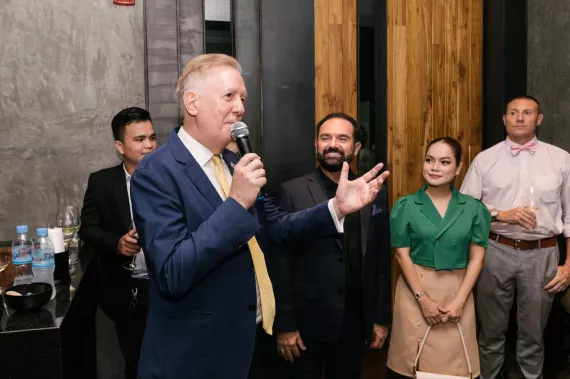
Anthony Galliano is the President of the American Chamber of Commerce (AmCham Cambodia) and Secretary General of the Cambodia Restaurant Association, amongst many other ventures. A long-time advocate for building a modern, meaningful and diverse economic environment within the Kingdom, he’s now signed up to be a mentor for Generation Future, where he’s been paired with Paniet Toeng and Feel the Deal, a project tackling food waste in Phnom Penh. We asked him about the crucial role of the private sector in empowering Cambodia’s youngest generation of changemakers.
What inspired you to join Generation Future?
First of all, it’s because I’m reaching a certain point in my career – I’m now 63 years old and have vast experience working all over the world. Starting my own business here, transforming from a very senior but salaried employee to an entrepreneur, I had to go through that learning experience myself in my late 40s. Now I get to help the new generation. For me that’s more than an honour – to be able to help people at this point rather than just manage our businesses for profit.
AmCham has also taken a very strong interest in CSR [Corporate Social Responsibility] and community work. As president, I’ve formed an advocacy committee to do this, and we’ve done a lot of work in the last two years. We’re looking at helping with skills development in Cambodia and lending a hand not only financially but from a human resource point of view. It’s a big effort on that part.
What is the role of the private sector in developing the skills of young people in Cambodia?
Developing employees through training and through assessing their talents is not something that I’ve seen a lot of in my 14 years here until recently. Cambodia didn’t really have a very strong human resource practice. Most companies even lacked HR departments.
I think it’s not about giving outside training but training within the organizations. The private sector can support these initiatives for smaller companies or for those that don't have access to training and skills development.
The youth are our future. That’s always been the case. The Cambodian youth I think have much better opportunities now than they would have had 10 years ago. The education system has certainly become much better. There’s a lot of room for skills development and mentorship for the Cambodian youth – we still find that in a lot of sectors, certainly the sectors that we’re in, the graduates really aren’t as well prepared as they should be to enter the workforce, when compared to other countries. We’re underdeveloped in the finance sector. We’re not seeing people qualified to the level of Hong Kong or Singapore or Thailand. It’s in our interest to get better skilled people.
What do you hope to contribute to the project?
To me it’s two-fold – it’s sharing personal skills that I have and skills that my network has. When I was working with Citibank, at the very senior level you had to mentor. I miss that. It’s good to get back to a hands-on, one-to-one basis – to see how I can help Paniet Toeng with Feel the Deal and also give her access to my network of people, which I think will be most valuable as she’ll have access to people that would be interested in supporting her. Secondly, I think before you put her in front of anybody, you would want her to be able to have good communication skills and presentation skills.