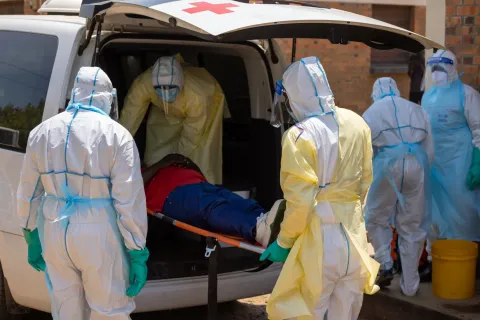
A story from the field: Ebola Preparedness in Rumonge, Burundi
Burundi is at high risk of cross-border transmission with the ongoing Ebola outbreak in the eastern regions of the Democratic Republic of Congo (DRC).

Rumonge, Burundi - Hundreds of people from the Democratic Republic of Congo (DRC) continue to cross into Burundi. Many Congolese travel daily to Burundi for trade and other socio-economic reasons.
According to the ‘’Chef of the Port’’, between 100 and 250 cross on market days through the port of Rumonge. With support of UNICEF Burundi and partners, health technicians are mobilized at entry points to screen people upon arrival.

People travelling from the Democratic Republic of Congo stand in line upon arrival for hand-washing with chlorine solution at the Ebola screening point at the border town of Rumonge. UNICEF and other partners are supporting this critical point of entry with WASH facilities and isolation equipment.

On the Port of Rumonge, there is one major ‘’Poste de Surveillances Medical’’, occupied by two health technicians and equipped with WASH facilities. This is the only response centre that screens incoming travelers from DRC at the Rumonge port. Here, the health technician is getting prepared to set up the hand-washing device.

The Rumonge medical screening post is equipped with an Ebola Treatment Unit to isolate any suspected cases with the help of the Red Cross and World Food Program. The health facility is located about 300 meters from the landing point on the shores of Lake Tanganyika, where hundreds of people from the DRC cross into Burundi, notably on market days.

Meters away from the isolation tent, health technicians set up the hand-washing device. Health technicians are in direct contact with more than 250 travelers every day. Rumonge port is a critical entry point and heath workers need additional protective equipment for their daily work. Here, the heath worker adds chlorine to water that incoming travelers will use to to clean their hands.

Incoming travelers from the DRC stand in the line to thoroughly wash their hands with chlorinated water before having their temperature taken as a precautionary measure.

Then, they continue their way to the center via a corridor for temperature reading.

Healthcare workers in charge of screening temperatures are at the highest risk of getting sick because they may come into contact with the body fluids of a sick person. Here, one of the center’s health professionals is wearing a gown, a mask, disposable gloves and eye protection. However, additional protective equipment is being provided to ensure total safety.

A Burundian health technician measures the temperature of a newly arrived mother and baby from the DRC with an infrared thermometer. All arrivals from the Democratic Republic of Congo are screened for the Ebola Virus Disease at the port of Rumonge, Burundi.

A health worker registers all incoming travelers after a negative test and explains the risks associated with Ebola and how one can protect themselves the contamination.

As part of the preparation of Burundi for the management of public health emergencies, and particularly for the Ebola epidemic, Rumonge is among the 10 priority health districts at the highest risk (Cibitoke, Mpanda, Bujumbura North, Bujumbura Center, Bujumbura South, Kabezi, Isale, Bugarama and Nyanza Lac). They all share a border with the DRC. These health districts are located in the Imbo Plain and along the Tanganyika Lake. The movement of goods and people between these locations in Burundi and the DRC's South Kivu region is regular and vital to the local economy.
Thanks to the support of several donors who had stepped forward to protect children in this emergency, UNICEF is able to work with partners to ensure that protective, preventative and contingency measures are in place.
For Every Child, health.