Learn Your Rights, Use Your Voice
Young trainers gained important knowledge about children’s rights, which they will pass on to children and young people in secondary schools across BiH

- Bosanski/Hrvatski/Srpski
- English
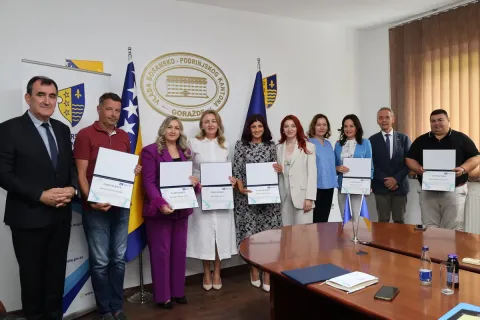
As part of the project “Learn Your Rights, Use Your Voice: Education on Children’s Rights in High Schools,’ a Coordinating Training for trainers was held in Sarajevo, organized by UNICEF in partnership with MreSVUBiH (Network of Student Councils in BiH). During the three-day intensive training, 15 experienced young trainers had the opportunity to get familiar with a new youth-friendly manual on children’s rights and develop skills for conducting future trainings with student council leaders across BiH.
Elzana Čović, one of the training participants who has worked with children and young people through MreSVUBiH activities for three years, emphasized the importance of gaining additional skills and knowledge in children’s rights:
“Since we work with secondary school students, it is very important that we are well acquainted with children’s rights and the best ways to teach them. Currently, children do not know much about their rights, and I believe awareness needs to be spread even more, especially through informal education like this. Each of us who completed this training will be an important channel for passing knowledge to children, who, thanks to what they learn, will be able to develop themselves further and actively participate in creating and influencing policies that affect them, thus creating new opportunities through additional education.”
Through this process, young participants gain practical knowledge of their rights and the ability to share it with their peers, making children’s rights understandable, applicable, and shared within the school community. They will learn what a workshop is and how to plan it, define common issues among secondary school students, create implementation plans for activities, and develop practical teamwork, communication, and facilitation skills to use in peer-to-peer education.
“One of the results of our partnership with UNICEF is the training on children’s rights for secondary school students. The goal is to build upon existing youth knowledge in peer-to-peer work, through methodology and the manual created with UNICEF and now finalized. After presenting the manual at the training, participants will have the chance to provide comments and suggestions for improvement, and it is planned that it will receive its final design in September,” said Ermin Mandžuka, Executive Director of MreSVUBiH, explaining the next steps after the trainers’ training:
“The trainings will be organized in all regions and cantons of BiH, and secondary school students will be trained to lead peer-to-peer education in their schools. From January next year, student council presidents will conduct workshops on children’s rights with their peers during council sessions, class meetings, and through school sections. In parallel, a competition is planned for secondary school students to create video materials on children’s rights, with the five best works being awarded,” added Mandžuka, highlighting the program’s significance: MreSVUBiH has signed memorandums of cooperation with all Ministries of Education in BiH and has national-level support, allowing uninterrupted work in secondary schools.


According to project data, currently only half of children aged 10–17 are aware of the Convention on the Rights of the Child (CRC), and only a third understand it. This gap can be addressed through peer-to-peer education, ensuring that education on children’s rights reaches nearly every secondary school in the country.
“This is the first in a series of events that involve you and will take us together with you to many schools in BiH. It is important and crucial to pass on knowledge about children’s rights and the CRC to all youth and children in BiH. Boys, girls, children with disabilities— all children in their diversity should have rights, but also participate and have the right to influence decisions that affect them and shape their lives,” said Marc Lucet, UNICEF representative in BiH, at the opening of the training.
Participants were also introduced to the U-Report platform, a communication channel that represents the voice of the public and promotes youth participation in creating positive social change. U-Report BiH aims to serve as a tool for exchanging information and collecting real-time data that government institutions, NGOs, UN agencies, media, and other partners can use to test, create, and analyze policies, strategies, or services based on real needs:
“So far, 70,000 children and young people in the Western Balkans have joined U-Report, and as you will see, it is very interesting. U-Report is a way to share your opinions and answer the questions we ask so that your voice can be presented to the government. This way, when I talk to ministers, governments, and our partners in Bosnia and Herzegovina, I can represent your views. It allows me to better understand what you think, and you better understand the important issues and how you can influence them,” said Marc Lucet, inviting participants to join U-Report and spread the word among other young people to expand the youth voice network.
Andrea Marinković from UNICEF’s Monitoring and Evaluation team emphasized the importance of the partnership with MreSVUBiH:
“Our joint goal is to promote children’s rights throughout society. In this project, we aim for children and youth up to 18 years old to be fully aware of their rights and responsibilities, as these rights are always there and cannot be taken away. Thanks to this partnership, we can reach a larger number of secondary schools across BiH and provide young people with the opportunity to learn more about their rights. Our goal is for all participants to better understand their rights and how to use and protect them.”