

23 New Supervisors in a Child Protection system of Republika Srpska
“The evidence is clear – when we ensure adequate support for social workers in the field, the entire child protection system becomes more effective.”

- Bosanski/Hrvatski/Srpski
- English
At the First Conference on Supervision in the Republic of Srpska, titled “The Importance of Supervision for Improving the Quality of Work in Social and Child Protection”, held in Banja Luka, 23 newly trained supervisors in psychosocial work were officially promoted and awarded certificates.
The conference was organized as part of the project “Implementation of Supervision in the Social Protection System of RS through Support for the Development of Supervisory Education and Practice”, funded by the European Union and implemented in cooperation with the Ministry of Health and Social Welfare of Republika Srpska, the Association of Supervisors in BiH, and the Faculty of Political Sciences in Banja Luka, with support from UNICEF BiH.
Andrea Puhalić, President of the Association of Supervisors in BiH, emphasized that the new supervisors will support social workers in their daily work, contributing to improved social and child protection:
“The primary function of supervision is protection from professional burnout, that is, psychological support and learning more effective strategies for coping with professional stress that social workers face daily. This is not a weakness, it is simply humanity – we are human beings first, and then social workers. The second function is support for personal and professional development provided by supervisors.”
Dean of the Faculty of Political Sciences in Banja Luka, Ranka Perić Romić, highlighted the importance of supervision for society as a whole and announced its upcoming inclusion in academic curricula:
“We always ask: If social workers provide social assistance and services to users, who provides support to them? In this sense, introducing supervision into the social protection system is of general interest to society, especially to service users. We plan to launch a master’s program in ‘Supervision in Social Work’ by 2026, elevating what this project started to an academic level.”
Maja Špica Knežević, Director of the Center for Social Work in Kozarska Dubica, spoke about supervision from the perspective of social work centers, stressing the complexity of the field:
“This work requires a high level of psychosocial, professional, and educational competencies, continuous professional development, and innovation to adequately respond to challenges while preserving the mental health of helpers. That’s why introducing supervision and its application in social protection is crucial – as a concept of lifelong learning and continuous professional support.”
Vladimir Nakić from the Center for Social Work in Petrovo, one of the newly promoted supervisors, shared his experience:
“There was great interest in the training, and those of us selected were enthusiastic and happy to learn from both local and international experts. We realized early on that these certificates would not come easily – we had to work and study hard. This training broadened our perspectives and gave us new knowledge and competencies.”


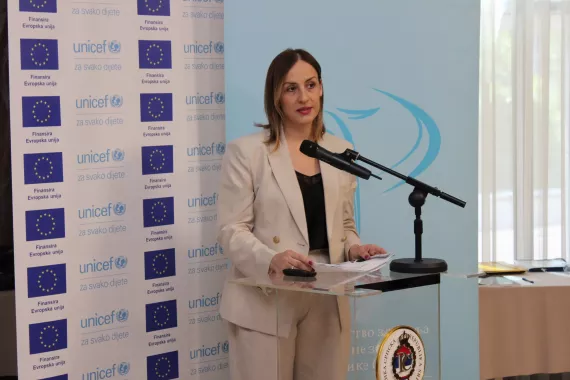


Vladimir Makarić, Assistant Minister of Health and Social Welfare, said the project’s positive outcomes are already visible:
“Around 16,500 users were involved in this project and will benefit from improved work by professionals who were supervised during the project. Supervision is recognized in the Strategy as important, with specific measures outlined.”
Minister of Health and Social Welfare of RS, Alen Šeranić, emphasized the increasing need for supervisory support and called for strengthening supervision:
“Let us use the time ahead to empower each other and continue working together to strengthen supervisory capacities. The measure of our success should be the well-being of users. I urge leaders of social protection institutions to recognize supervision as an opportunity to improve institutional work, increase staff satisfaction, and enhance service quality.”
This initiative is part of the UNICEF and EU partnership within the project “Strengthening the Social and Child Protection and Education Systems in BiH to Provide Inclusive Services and Prevent Institutionalization of Children”, funded by the European Union. UNICEF Representative in BiH, Marc Lucet, emphasized:
“Supervision provides essential support to social workers facing complex challenges, helps maintain professional standards, improves decision-making, and ultimately leads to better outcomes for children and families. Effective implementation of the Strategy for Social and Child Protection and the Roadmap for Deinstitutionalization is crucial – not only for protecting the rights and well-being of vulnerable children but also as a strong investment in human capital and workforce development in the social protection system.”
The European Union continues to invest in strengthening the social protection system in BiH, focusing on supporting the most vulnerable groups, including children without parental care and persons with disabilities. The EU is currently funding several projects worth €9.45 million in cooperation with UNICEF, NGOs, and local authorities. These projects aim to strengthen alternative care models for children and improve services for children and adults with disabilities across the country.
“Social protection is about dignity, inclusion, and opportunity for every citizen. The European Union is proud to support BiH in strengthening these systems, helping vulnerable groups, and building a fairer society for all. Together with partners like UNICEF, we are investing in reforms and laying the foundation for a more just and prosperous society that reflects EU values,” said Biljana Barović, Acting Head of the EU Office in Banja Luka.
