

Western Balkans conference calls for stronger action on air pollution to protect children
- Bosanski/Hrvatski/Srpski
- English
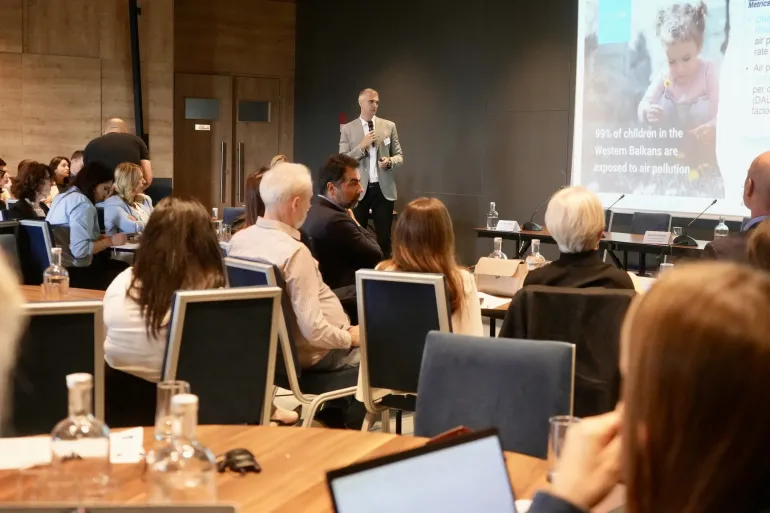
Sarajevo, 4 June 2026 – A regional conference held in Sarajevo on 3rd and 4th of June, sent a clear message: clean air is vital for every child. Yet poor air quality remains the leading environmental threat to children’s health in the Western Balkans, with 99 per cent of children breathing polluted air in their homes, schools, hospitals and playgrounds, with potentially fatal consequences.
The two-day conference, From Data to Action: Air Quality, EU Accession, and Youth as the Next Generation of Environmental Leadership in the Western Balkans, aimed to accelerate action on air pollution, strengthen alignment with EU standards and support the participation of children and young people in environmental decision-making. It marked the culmination of the four-year Partnership for Improving Air Quality in the Western Balkans (2022–2026), implemented by the Swedish Environmental Protection Agency (SwEPA), UNICEF and the Swedish Meteorological and Hydrological Institute (SMHI), with funding from the Swedish International Development Cooperation Agency (Sida).
The conference highlighted the results of the Partnership and brought together government representatives, environmental and education authorities, municipal, youth advocates and technical experts from Albania, Bosnia and Herzegovina, Kosovo[1], Montenegro, North Macedonia and Serbia.
From monitoring to implementation: supporting EU accession
One key focus for the Partnership has been the region’s alignment with both Chapter 27 of the EU acquis on environment and climate change and the Ambient Air Quality Directive. Conference participants discussed how data, monitoring and institutional capacity support practical compliance, including air quality plans that protect children and other groups most at risk.
Youth as drivers of change: from advocacy to local action
The conference highlighted the work of young people across the Western Balkans on air quality in their own communities. With training from the Partnership, more than 11,000 young people have led 200 environmental initiatives across 97 municipalities to reach 500,000 people. In Bosnia and Herzegovina, young people have contributed to the Tuzla Canton Air Quality Action Plan, which recognizes children as a vulnerable group and includes measures such as replacing coal stoves and promoting solar energy.
In Kosovo, youth consultations have shaped the first voluntary Nationally Determined Contribution (NDC) and the Climate Change Adaptation Strategy. In Serbia, young volunteers have reached more than 480 families with information on cleaner and more efficient heating options, as well as available subsidies. In Albania, young people have taken part in Tirana’s public consultation on the Air Quality Plan, pushing for strong enforcement, reduced traffic and more green spaces. In Montenegro, a youth reference group worked with the Government Environment Protection Agency to improve public communication of air-quality data.
Marc Lucet, Representative of UNICEF in Bosnia and Herzegovina, said: “Through this partnership, UNICEF has worked with government institutions to move climate and air quality education from project activities into formal systems. By embedding new materials, teacher training and youth participation mechanisms into official platforms, curricula and institutional processes, we are helping ensure that children and young people gain the knowledge, skills and opportunities to contribute to cleaner air and a greener future.”
Building lasting capacity: strengthening education and professional learning
In cooperation with government institutions, the partnership has delivered concrete results in education. These include support for 85 educational products on environmental issues, reaching nearly 40,000 teachers and more than 620,000 children. In North Macedonia, 28 new curricula on environmental issues, together with supporting learning materials, have reached around 9,000 vocational secondary students, while 308 students have completed green internships.
In Albania, a Teacher Manual on Climate Change for grades VI–IX and Guidelines on Integrating Green Competencies in Pre-University Education have reached more than 200,000 children. In Serbia, UNICEF supported the Institute for Education Quality Evaluation in assessing seventh-grade students’ climate and ecological literacy, generating insights to improve education quality and encourage informed, environmentally responsible behaviour. In Kosovo, teacher training modules on sustainability, climate change and air quality have been accredited for inclusion in the official curricula. In Bosnia and Herzegovina, environmental education content was developed for pre-primary education, alongside a digital course on air pollution for undergraduate students at the University of Sarajevo.
This partnership has also included the EU Environment Academy, a long-standing training programme developed by SwEPA to strengthen the capacity of public officials and young professionals in environmental governance and EU integration at local and national level. Its 35 participants have also focused on the revised Ambient Air Quality Directive, combining policy discussions with practical case studies on management and implementation. They have now joined a growing regional alumni network of approximately 150 professionals from across the Western Balkans that will continue to exchange knowledge and experience to support further regional cooperation.
Stefan Nyström, Head of Department Climate and Air at SwEPA, said:
“Through our partnership with public institutions throughout the region, UNICEF and SMHI, we have invested in the next generation of environmental professionals and decision-makers. By creating spaces for dialogue, shared learning and collaboration, the programme has helped build a common vision for cleaner air, grounded in both evidence and lived experience. This shared understanding will be critical for advancing effective policies and sustaining progress towards cleaner air across the Western Balkans.”
Regional recognition and next steps
The Regional Cooperation Council has recognized the Partnership as a contribution to implementing the Green Agenda for the Western Balkans. Conference participants also discussed how progress can be sustained beyond 2026 through continued investment in green skills, climate education and stronger institutions.
The conference closed on 4 June with a shared commitment to deepen regional cooperation and accelerate action to protect children’s health, strengthen institutions and support implementation of the EU acquis on environment and climate change.
####
Note to editors
About the partnership
The Partnership for Improving Air Quality in the Western Balkans (2022–2026), funded by Sida and implemented by SwEPA, UNICEF and SMHI, supports six Western Balkan territories in strengthening air quality governance, improving data and monitoring, reinforcing education systems and expanding public participation, with a particular focus on children’s health and youth engagement.
Media contacts
O UNICEF-u
UNICEF djeluje u nekim od najugroženijih područja na svijetu, kako bi obuhvatili djecu iz najranjivijih kategorija. Širom 190 država i teritorija, mi radimo za svako dijete, bilo gdje, kako bi sagradili bolji svijet za sve. Mi nikad ne odustajemo.
Za više informacija o UNICEF-u i našem radu za djecu, posjetite www.unicef.org.
Pratite UNICEF u BiH na Twitter-u, Facebook-u, Instagram-u i Youtube-u