Ministry of Education & Skills Development and UNICEF observe first International Day Of Play
The Day was marked to highlight the importance of play in children’s learning and wellbeing

JOINT PRESS RELEASE
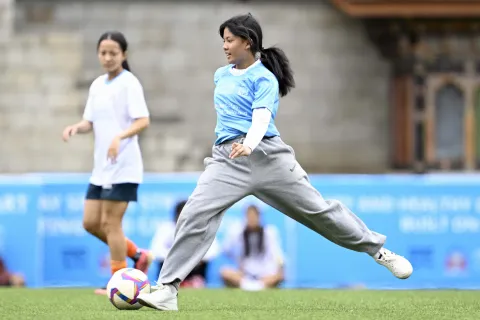
Thimphu, June 11 2024: Recognizing the importance of play as central to children’s learning and well-being, the Ministry of Education and Skills Development (MoESD) in partnership with UNICEF Bhutan celebrated the first International Day Of Play at the Changlingmithang stadium today.
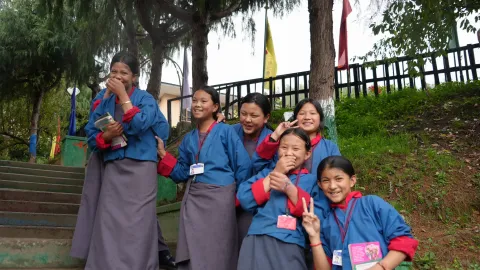
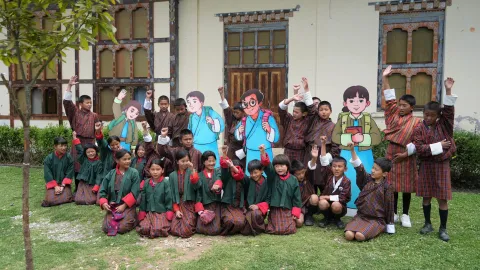
More than 250 students from 15 schools across Thimphu including monks, children with disabilities and children from early childhood care and development (ECCD) centres participated in the national event where various health and physical education sessions were organised by 65 School Sports Instructors. All 442 public ECCD centres across Bhutan also celebrated the day in their communities.
On March 25, the United Nations General Assembly adopted a resolution to create a new International Day of Play, with more than 140 countries as co-sponsors. The annual International Day of Play will take place on June 11 every year, beginning in 2024.
The declaration named UNICEF and UNESCO as joint coordinators of this day to be celebrated annually, through activities aimed at education and making play an integral part of a happy, safe, healthy, and nurtured childhood.
Education and Skills Development Minister Yeezang De Thapa joined the children and teachers at the celebration.
“The international day of play marks a significant milestone in efforts to preserve, promote and help our children learn and grow,” the minister said. “The Ministry will be ever ready to support in educating our children through various engagements – be it a play, music or art.”
According to MoESD officials, play in its various forms—fun activities, recreation, or competitive games—plays a crucial role in fostering physical, social, emotional, and cognitive development, especially in children. Contrary to the assumption that play, sports and physical activities deter academic performance, education officials reiterated that sports and physical activities have a positive impact on the overall wellbeing and academic performance of children.
To provide a holistic development learning environment that nurtures children academically, physically, emotionally, and socially, the MoESD mandates schools to implement regular health and physical education programmes, ensuring that children receive a minimum of 60 minutes of quality physical activity each day as per the World Health Organization guidelines. This was reiterated through a circular on June 18, 2021.
Additionally, fitness tests conducted on students also indicate concerning findings of children being overweight or underweight and needing improvement in their physical wellbeing.
Article 31 of the Convention on the Rights of the Child (CRC) recognizes the right of every child to rest, leisure, play, recreational activities and free and full participation in cultural and artistic life.
UNICEF Bhutan Representative Andrea James said the International Day of Play is an opportunity for all policy makers, parents and caregivers to elevate the importance of play as central to children’s learning, development, and well-being.
“It is an opportunity for us to strengthen policies, training, and funding to get play integrated into education and community settings worldwide,” Andrea James said. “Now more than ever, we will need to work together towards the creation of safe spaces at homes, in schools and communities so that children can explore, imagine and connect through play. Given the risks associated with prolonged screen time on children’s wellbeing, UNICEF urges parents and caregivers to replace this with engaging activities that strengthen the bond between parents and children.”
In 2013, the UN Committee on the Rights of the Child, concerned by the poor recognition given by States to the rights contained in Article 31, issued the General Comment 17 on the right of the child to play. The General Comment stated that, “each element of Article 31 is mutually linked and reinforcing, and when realized, serves to enrich the lives of children. Together, they describe conditions necessary to protect the unique and evolving nature of childhood. Their realization is fundamental to the quality of childhood, to children’s entitlement to optimum development, to the promotion of resilience and to the realization of other rights.”
Marked during the global parenting month, the observation of the first international day of play emphasizes the critical role parents and caregivers have on the development of emotional and social skills that support children’s mental health and well-being. To support children’s learning, promote engaged parenting and provide ECCD facilitators with age-appropriate resources for children, a private firm Educare Skill, the country’s first online platform announced a month of free subscription to its content for all ECCD centres in Bhutan.
Global data shows that approximately 4 in 10 children aged 2-4 years do not get enough responsive interaction or stimulation at home and around 1 in 5 children aged 2-4 years do not play with their caregivers at home.
While its importance is recognized, children’s right to play is not universally enjoyed as it should be. These barriers are:
- Play is undervalued and trivialized: Research shows play that is child-centred learning inspires learning, and children’s motivation to-learn, much more effectively than teacher-centred instructional learning. However, in many countries, a culture of over-testing and exams is further turning children off learning and squeezing out prospects for play in curricula, teacher development and capacity.
- Opportunities for play are being squeezed out of childhood: Research shows children are enjoying much less child-led, free play outdoors then their parents did as children. A culture of ‘safetyism’ and a transition from play-based to smart phone-based childhoods deny normal play opportunities with potentially catastrophic consequences for mental health.
- A significant number of children are deprived of play at home. Play is dependent on parental/caregiver relationships providing a safe and loving attachment and a secure base from which to explore. Children growing up with inadequate playful interactions at home don’t feel loved or safe and often live in survival mode which inhibits free play.
These barriers can, however, be addressed. UNICEF and partners call on policy makers to prioritise four SDG-related outcomes most likely to fulfil the right to play and accelerate progress towards SDG targets:
- Universal access to evidence-based parenting programmes that promote attachment, playful parenting and buffer children from external shocks and prevent potential risks such as excessive screen time.
- Universal access to quality, inclusive early childhood education, including learning through play, for children between three and six.
- Protection of public spaces and care environments from environmental and climate change, conflict, and urbanization.
- Integration of play-based teaching and learning practices into schools and other learning environments, including innovations.
UNICEF Bhutan Representative Andrea James commended the Royal Government of Bhutan for paving the way towards realizing these goals by recognizing and marking the first International day of play. “This shows the Royal Government’s commitment towards ensuring the wellbeing of children across Bhutan and the critical role play plays in securing the rights of every child.”
###
Access photos here
For additional information, contact
Nima Gyeltshen, Chief Sport Coordinator, MoESD, [email protected], 17602631
Pema Tshomo, Education Officer, UNICEF Bhutan [email protected] 17111716
Media contacts
About UNICEF
UNICEF promotes the rights and wellbeing of every child, in everything we do. Together with our partners, we work in 190 countries and territories to translate that commitment into practical action, focusing special effort on reaching the most vulnerable and excluded children, to the benefit of all children, everywhere.
For more information about UNICEF and its work for children, visit www.unicef.org.