Central Monastic Body and UNICEF launch Integrated Child-Friendly Intervention in Monastic Schools
The comprehensive child-centred package of services is provided towards making monastic schools child -friendly and to meet the holistic needs of children
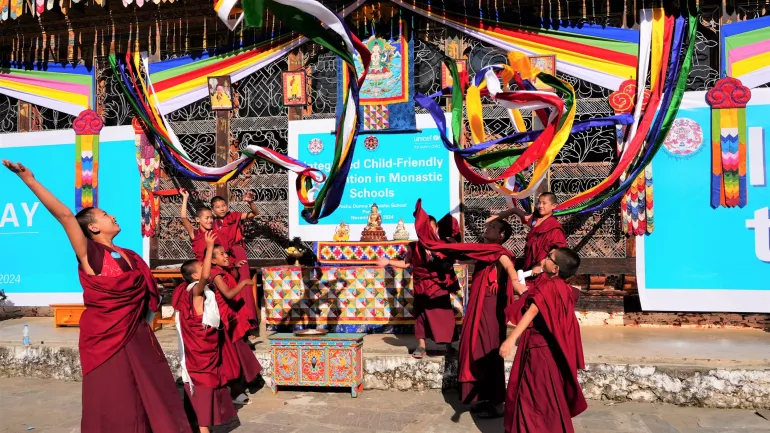
PUNAKHA, 20 November 2024 – Bringing together the foundational needs of children in health, water, sanitation and hygiene, nutrition, education, protection and play into a comprehensive child-centred package of services, the Central Monastic Body and UNICEF today launched the Integrated Child-Friendly Intervention (ICFI) in monastic schools to mark World Children’s day today.
The package was put together in consultation with children in three pilot monastic schools including a nunnery across the western, central and eastern regions. During the consultation, children shared their ideas of a child-friendly school and how such a school would help them realize their hopes and dreams.
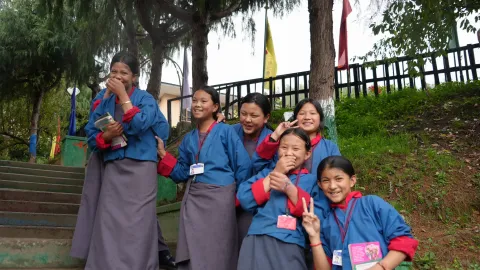
At Phochu Dumra monastic school, one of the three pilot schools, about 300 child monks, representatives from the Central Monastic Body, the Government, local government and UNICEF came together to celebrate the Day themed, “Listen to the future.”
One of the students at the monastic school, Dorji Norbu, 8, said he wants to become the Head Monk of his district while Ngawang Nidup, 10, wants to be one of the five eminent lopons of the Central Monastic Body. Some aspire to become expert mask dancers and spiritual leaders while others shared of becoming artisans, traditional medical doctors, and teachers.
“When we listened to these children’s aspirations during a consultation earlier this year, it was for the first time that they had been heard. And it was also the first time that the teachers and students had come together to discuss their aspirations to make their school better,” UNICEF Bhutan Representative Andrea James said. “UNICEF marks 50 years of partnership with the Royal Government of Bhutan this year. We mark this occasion with a new renewed approach to converge our work so that every child in every part of Bhutan has every opportunity to grow into their full potential.”
His Eminence the Machen Zimpon at Punakha Dzong, Lam Namgay Wangchuk graced the celebration along with the Cabinet Secretary and Chairperson of the National Commission for Women and Children, Kesang Deki.
“Everything works wonders when we all have the same passion, same commitment and when we work together. I would like to thank UNICEF for always being there in partnership with the Royal Government of Bhutan,” the Secretary said. “As we celebrate World Children’s Day, let us remember that every child deserves to be cherished, empowered and given the opportunity to reach their full potential. On behalf of the government, let us today aspire to work together to build a brighter future for the children of Bhutan and beyond.”
The World Children’s Day celebration this year, held away from the capital in Punakha was organised with the Central Monastic Body to mark the launch of the ICFI and celebrate the 50th anniversary of UNICEF’s partnership with the Royal Government of Bhutan.
Punakha Dzongdag Thuji Tshering said, that ensuring children’s wellbeing is not only their right, but a collective responsibility to ensure a responsible global citizenry. “We need to invest in the future, which means investing in our children and improving the wellbeing of all children. We in Bhutan are fortunate because we have great support from the highest authority.”
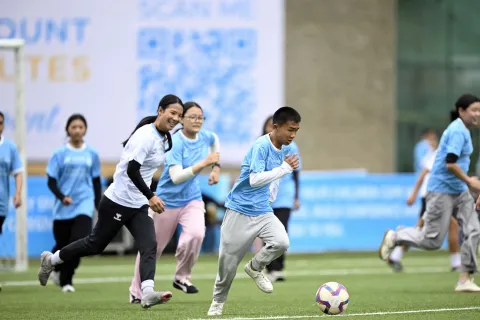
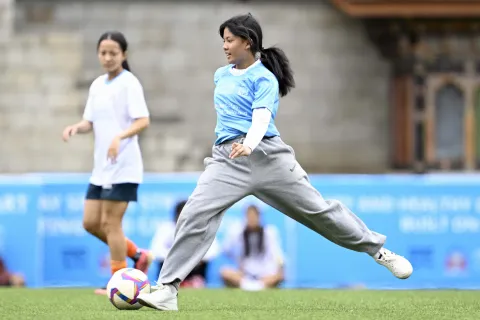
During the celebration, UNICEF and the Central Monastic Body distributed reusable water bottles to the children to support the school towards reducing the use of plastic bottles and inaugurated the school’s new futsal and volleyball grounds. As part of the pilot programme, the school’s toilets and bath areas were renovated and the teachers and students re-oriented in child safeguarding and protection measures. The school also teaches English and digital skills through the Akelius project.
UNICEF’s flagship report - The State of the World’s Children 2024, that focuses on The Future of Childhood in a Changing World was also released at the celebration. The report projects how three major global forces – or megatrends – will impact children’s lives by 2050 and beyond. The megatrends – demographic change, climate and environmental crises, and breakthrough technologies – provide key indications of the challenges and opportunities children may face in the future.
The pilot ICFI approach converges different programmes into one package and is expected to be a model for other monastic schools to benefit around 9,000 child monks and nuns across Bhutan.
Download photos here https://bit.ly/3ZebrJ7
Note to editors
About Integrated Child-Friendly Intervention
A Situational Analysis on the Development of Child-Friendly Education Interventions for Young Monks and Nuns in Monastic institutions, 2023 showed various challenges affecting the wellbeing of children living in monastic institutions and nunneries. Most of these schools lack a comprehensive programme for child-friendly care and development. These include -
- Inadequate living spaces and infrastructure including cramped sleeping quarters or absence of separate sleeping quarters, dining, and classroom facilities.
- Limited or lack of age-appropriate toilets and sanitation facilities and poor hygiene practices.
- Irregular water supply (poor water supply infrastructure, natural cause like sources drying).
- Limited opportunity for contemporary and child-friendly learning and age-appropriate environment and approaches. Lack of age-appropriate learning materials.
- Absence of child-friendly and age-appropriate education skills and capacity among teachers.
- Inadequate nutritional food and balanced diet and lack of vitamin supplementary programme.
- Inadequate kitchen hygiene and capacity of kitchen staff
- Scattered and unsubstantiated child abuse incidences reported despite awareness and sensitization programmes.
- Limited or absence of knowledge, skills and awareness on child-friendly education and health and nutrition management among principals, teachers and senior monks in monastic institutes and nunneries, including the caregivers.
While the Central Monastic Body) with support of the government and development partners have initiated various interventions ranging from WASH facilities, health and nutrition, education, and protection services including inclusive social protection to improve the situation of the child monks and nuns, most of these interventions are implemented in sporadic silo approaches limiting impactful results.
Considering these gaps, UNICEF in collaboration with Central Monastic Body including the Bhutan Nuns Foundation initiated a pilot Integrated Child Friendly Intervention (ICFI) with the aim to:
- Improve coordination and collaboration among implementing partners for more impactful results.
- Improve capacity among school principals, teachers, staff, children, and other caregivers in providing child centered services.
- Improve coordination between monastic institutions and nunneries and service providers in districts.
- To provide coordinated comprehensive child friendly services to child monks and nuns
The pilot initiative is implemented in three monastic schools including a nunnery and scaled to other schools and institutions. The three pilot institutions selected based on the number children and regional representation recommended by the Central Monastic Body are:
- Phochu Dumra Monastic School, Punakha, Western Region
- Kuenphen Yoedsel Choedling, Mongar, Eastern Region
- Ngajur Pemacholing Nunnery, Zhemgang, Central Region
Media contacts
About UNICEF
UNICEF promotes the rights and wellbeing of every child, in everything we do. Together with our partners, we work in 190 countries and territories to translate that commitment into practical action, focusing special effort on reaching the most vulnerable and excluded children, to the benefit of all children, everywhere.
For more information about UNICEF and its work for children, visit www.unicef.org.