Building a stronger health system for every child in Belize
2025 Annual Report
UNICEF is strengthening national systems to deliver better health, WASH and care for children and adolescents

Belize’s children deserve a health system that protects, nurtures, and empowers them from the earliest days of life to adolescence. In 2025, UNICEF Belize worked hand‑in‑hand with national counterparts to strengthen health systems at every level; from community outreach to hospital care, from clean water in remote villages to mental health support for teens.
At the close of 2025 system‑level reforms, innovation, and strong government partnerships are transforming health outcomes for children across the country.
A stronger, more resilient health system for children
UNICEF’s work in Belize is more than delivering services; it’s about changing systems, building institutional capacity, and ensuring sustainability long after project cycles end. In 2025, this included:
- Strengthening service delivery, governance and planning in primary health care
- Improving data, training, and tools that health workers rely on every day
- Embedding WASH and infection control standards across facilities
- Expanding climate‑resilient infrastructure to keep services running during emergencies
All of these efforts move Belize closer to a health system that can withstand climate shocks, support growing communities, and ensure that every child, wherever they live, whoever they are, can access quality care.
Advancing newborn health and care for premature babies
Belize made meaningful strides in 2025 to give every newborn, including premature and low‑birth‑weight babies, a healthy start. UNICEF’s technical leadership helped scale high‑impact maternal and newborn interventions nationwide, including:
UNICEF’s technical leadership helped scale high‑impact maternal and newborn interventions nationwide, including:
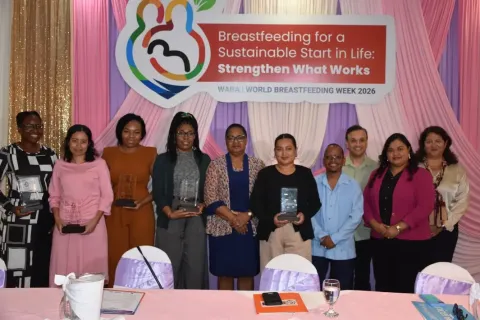
Training the first national cohort of certified lactation counselors, improving breastfeeding support for new mothers.
Expanding Kangaroo Mother Care (KMC) services to 50 health facilities, promoting bonding, warmth, and improved outcomes for premature babies.
Introducing perinatal mental health services into primary care:
- 600+ health workers trained
- Over 2,000 mothers screened for mental health concerns
Modernizing national protocols and strengthening lab capacity to prevent mother‑to‑child transmission of infections.
Additionally, UNICEF-supported improvements in infection control and quality of care reached an estimated 5,500 newborns delivered in health facilities across Belize.
These achievements reflect a strengthened, more integrated health system that is better equipped to support mothers and newborns at every stage of care. By combining evidence-based interventions, workforce development, and system-wide improvements, UNICEF is helping Belize ensure that every child, especially the most vulnerable, has the best possible start in life. In partnership with the Ministry of Health & Wellness and other national partners, these efforts are laying a sustainable foundation for healthier families, improved survival outcomes, and a future where no newborn is left behind.
Supporting healthier adolescents through better systems and services
Adolescents in Belize face growing concerns related to mental health, substance use, and limited access to youth‑friendly services. UNICEF’s system‑strengthening work in 2025 focused on equipping institutions and service providers to respond better.
Key achievements include:
xxx
A national situational analysis on adolescent substance use to inform policies and prevention programmes.
Training 75 service providers to deliver more adolescent‑friendly, stigma‑free care.
Digitizing the Helping Adolescents Thrive (HAT) programme and embedding it into the National Teachers Learning Institute, with 200+ teachers trained resulting in a major step toward institutionalizing mental health support in schools.
Empowering 16 youth leaders to shape national climate and health policy by contributing directly to Belize’s NDC 3.0 development.
These achievements demonstrate a stronger, more responsive system that is better equipped to support adolescents at a critical stage of their development. By investing in evidence, building the capacity of service providers and educators, and elevating youth voices in policy processes, UNICEF is helping Belize create an enabling environment where adolescents can access respectful, stigma-free services and actively shape the decisions that affect their lives. Together with partners, these efforts are laying the foundation for healthier, more resilient young people and a future where every adolescent can thrive.
In partnership with the Ministry of Health & Wellness and the Department of Human Services, these reforms support adolescents gaining better access to supportive, responsive health services, while their voices help shape the system built to serve them.
Strengthening community health
Community health workers (CHWs) are often the first and only link to health care for families in rural and hard‑to‑reach communities. In 2025, Belize took a major step forward by developing its first National Community Health Strategy, aligned with the Health Sector Strategic Plan 2025–2034.
UNICEF supported this milestone by:
UNICEF supported this milestone by:
Convening the first national Community Health Workers stakeholder forum to align priorities and chart a unified national direction.
Establishing a technical working group to guide quality and consistency across the Community Health Workers programme.
Introducing Talking Book devices an innovative tool that delivers health and behavior‑change messages in local languages for families in remote communities.
These improvements are helping Belize build a stronger, more efficient community health system ensuring families receive trusted, culturally relevant care close to home.
Rejuvenating WASH services across southern Belize
Clean water and safe sanitation are the backbone of good health. In 2025, UNICEF supported a major expansion of climate‑resilient water systems in 20 hard‑to‑reach communities, including many in the southern districts that face longstanding inequities.
Through partnerships with government and village water boards, UNICEF helped deliver:
xxx
Solar‑powered water systems that guarantee sustainable access during outages.
Rainwater harvesting systems and water treatment solutions.
Reliable safe water access for over 50,000 people, including approximately 7,500 children.
At the facility level, UNICEF strengthened environmental health and infection prevention by introducing the WASH FIT framework across hospitals and polyclinics nationwide ensuring cleaner, safer spaces for mothers, newborns, and children.
Together, these achievements underscore a significant step forward in ensuring equitable access to safe, reliable water and sanitation for underserved communities in Belize. By combining climate-resilient infrastructure with strengthened standards for hygiene and infection prevention in health facilities, UNICEF is helping to protect the health and dignity of children and families. In partnership with the Ministry of Rural Transformation, Community Development, Labour and Local Government and communities, these efforts are building more resilient systems that not only meet immediate needs but also safeguard the well-being of future generations.
Looking ahead

Belize’s health system is on a transformative path. UNICEF will continue working with government and partners to:
- Scale the National Community Health Strategy
- Strengthen adolescent health services nationwide
- Expand WASH FIT across all facilities
- Strengthen newborn health and maternal mental health care
- Accelerate climate‑resilient health and WASH infrastructure
System strengthening takes sustained effort but the impact is lasting. Our collective efforts are building a healthier Belize, one where every child survives, thrives, and grows up in a safe and supportive environment.