Safer schools, secure futures
In partnership with the European Union in Afghanistan, UNICEF is ensuring children have safer, more conducive learning environments to pursue an education


Sadaf
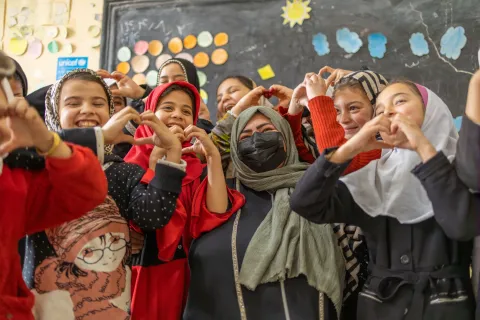
Sadaf is one of 4,000 girls enrolled in her girls’ school in western Afghanistan. She loves to learn, but struggled to stay in school when her time of the month approached. Her school did not have clean toilets, running water, or even soap where she could wash her hands.
“I am 11 years old now. I know there will be many changes in my body as I grow up, but I know it is normal.”
Unfortunately, Sadaf is not the only young girl struggling to maintain good hygiene. Over half of schools in Afghanistan do not have clean drinking water, and more than one-third do not have toilets with a place students can wash their hands.
This year, UNICEF partnered with the European Union to improve school buildings and classroom environments in 385 public primary schools in Afghanistan, so girls and boys can focus on what really matters: learning. This means rehabilitating classrooms, building toilets and water systems, and even training teachers.
“There are also so many diseases around, so it is really important to stay healthy and keep our hands clean,” says Sadaf.
“Some girls used to skip school, but now that we have clean toilets, we can easily wash ourselves. I love my school and I am very happy to come to class.”

Fariza
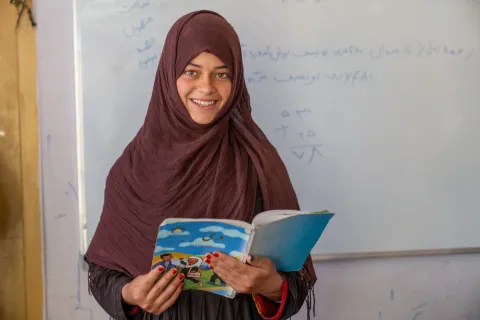
Less than half of children under 12 are attending primary school, and 60 per cent of those not in school are girls. But 13-year-old Fariza is not one of them.
"I love school. It brightens my future, builds up my education, and I learn about life," says Fariza.
In 2023, UNICEF supported 5.7 million children in public schools – 40 per cent of them girls – with education supplies like textbooks, learning supplies, classroom materials and backpacks. This year, as part of UNICEF's partnership with the European Union, more than 200,000 more children will enroll in primary school.

Rahima
Infrastructure and safe schools are just a piece of the puzzle to build a quality education.
In Afghanistan, the quality of learning is among the lowest in the world.
Just over 13 per cent of children in Grades 2 and 3 have basic reading skills, and only 18 per cent have basic numeracy skills.
But Rahima, a teacher in Afghanistan's central highlands, wants to change that.
"I have been teaching for eight years, and I absolutely love it," she says.
UNICEF and the European Union are training 3,850 educators to improve the quality of teaching, especially in the early grades where a strong foundation of learning is so important.
Rahima hopes there will be more like her.
“It is great seeing the changes I can bring to children and the wider community.”


Amina
Education offers a ladder out of poverty and a pathway to a better future. But education also takes many forms, and 15-year-old Amina (name changed) learns in a classroom of a different kind.
For some girls, vocational education offers opportunities towards self-employment and a reliable income. Amina joined a tailoring class in 2023, after she realized that secondary schools would still remained closed for girls.
"I joined this tailoring class since I could no longer attend school," says Amina. "I have learnt so much and I am able to sell some of my dresses in the local market so I can support my parents and siblings."
"In the future, I want to teach tailoring to other women in my community, so I can help them in the same way I’ve been helped."