Reconstructing her happy place
Amena’s school was a bastion of delight and discovery, until it washed away in last year’s floods. But this year, it is the first of hundreds to be rebuilt.
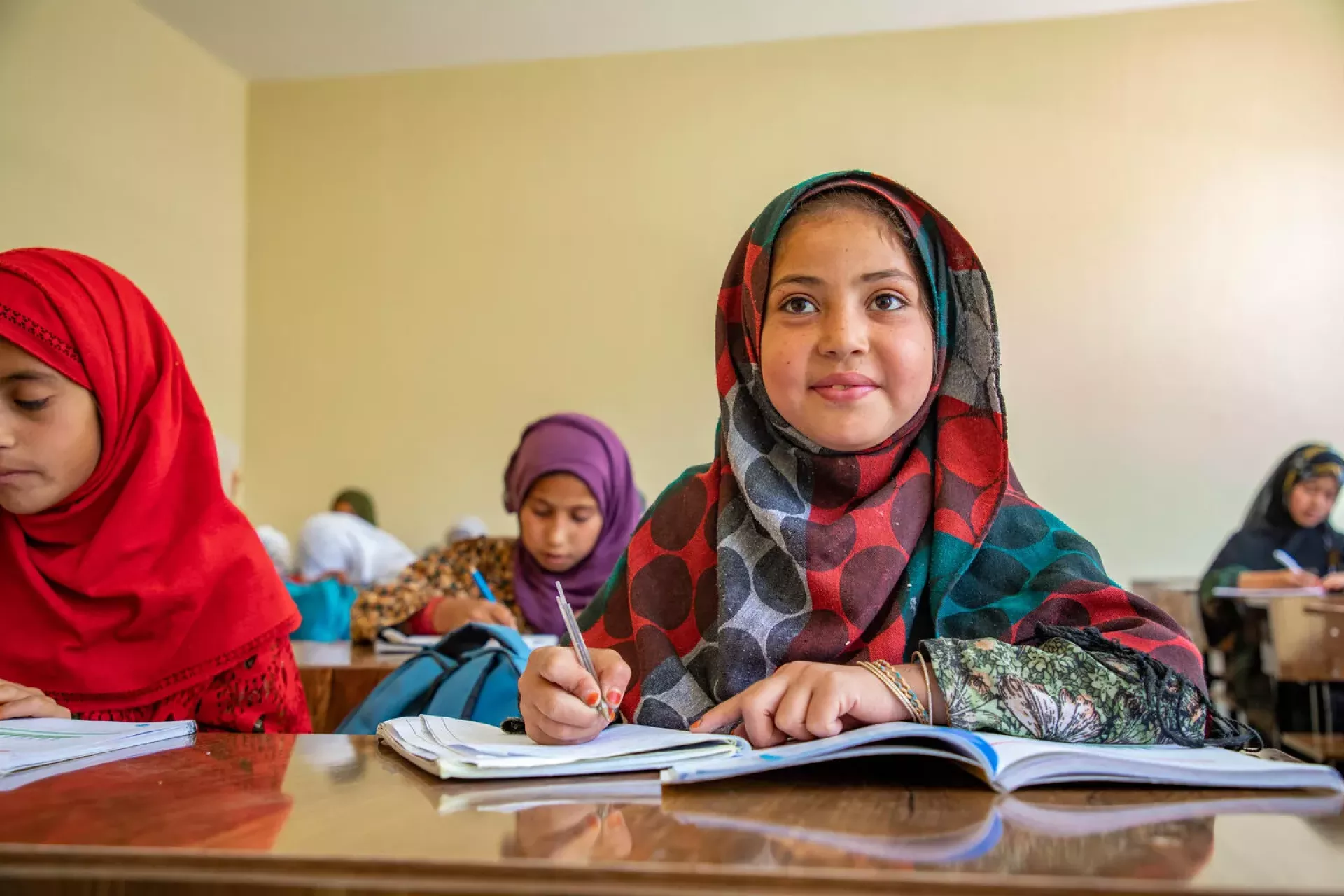
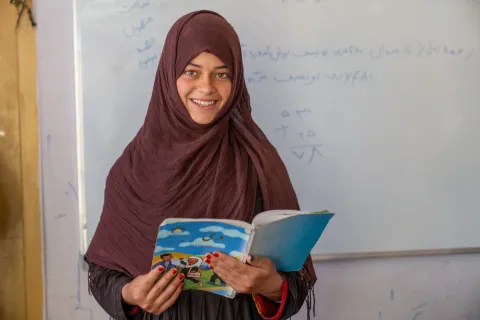
Amena sits in class with a bright smile, her pen poised for action. The 11-year-old is an avid student, eyes glued to the teacher, quick to volunteer her knowledge with a raised hand and pointed finger.
School, for Amena, is a joyous place. She looks forward to studying each day, plus the simple moments: meeting with friends; sharing a laugh in the schoolyard.
But a year ago, this light was darkened by tragic loss. In Amena’s village – and many others in northern Baghlan province – horrendous flash floods swept through neighbourhoods, claiming lives and destroying homes, health centres, water systems and schools – including Amena’s.
She recalls that time with grim clarity.
“Last year when the floods came, it was the hardest time of my life.”

UNICEF/UNI576401/Meerzad
Nearly 450 people were killed in last year’s floods, including 10 children. Many more were injured, and more than 70,000 peoples’ homes were damaged or destroyed.

UNICEF/UNI577680/Khayyam
Amena’s school – Shaikh Jalal High School – was one of 100 that were so damaged, children were forced to stop attending.
“When the floods came, I was very scared,” Amena recalls. “I was inside our home, but my brother was outside playing with my cousins. My father went to bring them inside, but he was taken by the flood.”
Three months later, Amena’s mother also passed away. With no known health issues, Amena’s relatives surmised that it was grief that claimed her.
Amena was grief-stricken, and could not even find comfort in the walls of her school or the distracting delight of learning.
“When our school closed, I missed studying so much.”
“I missed my teachers, my classmates – I missed everything. I was very upset and prayed every day that the school would reopen.”
“At home, I helped with chores, and I waited.”


“Eventually, we were able to study again, but we were under tents.”
“There were no chairs. No tables. No blackboard. When it rained, the tent would shake and sometimes fall. It was really hard to learn like that.”
A rickety tent is no place for learning, and certainly not a safe place where children should spend their day. Schools should be safe havens for children, conducive to learning, offering clean, functional classrooms and facilities. Trained, enthusiastic teachers. School supplies, so children can be successful in their lessons.
This ethos is the foundation of UNICEF’s partnership with the European Union, which supports Afghan schools holistically: renovating classrooms, building gender-segregated toilets, handwashing facilities and boundary walls, and training teachers in student-centred pedagogy to improve foundational learning in early grade reading, writing, and arithmetic.
Through this partnership, UNICEF is renovating 336 schools – benefiting more than 300,000 children – and training more than 5,000 teachers and school administrators.
Amena’s school is among the first two to be completed.

Amena lives with her elder brother now. Nearby: Her elder sister and her sister’s husband, Abdul Qahar, who helps look after her.
“Since the school was rebuilt, children have shown more interest in learning,” says Abdul Qahar. “The flood caused serious damage to our people. But now our children go to school with motivation and excitement.”
“For Amena, it has become a place of hope again.”

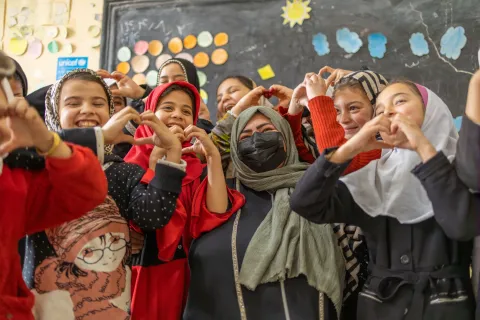
Now in grade 6, Amena bounces off to school each day with her friends, with much of her enthusiasm from a year ago restored.
“My favourite thing is still studying,” Amena says.
“Now the school is rebuilt and I feel happy again. I can sit in a new classroom, learn properly, and be with my best friend Halima.”