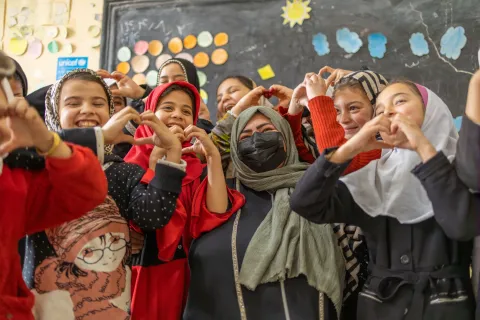
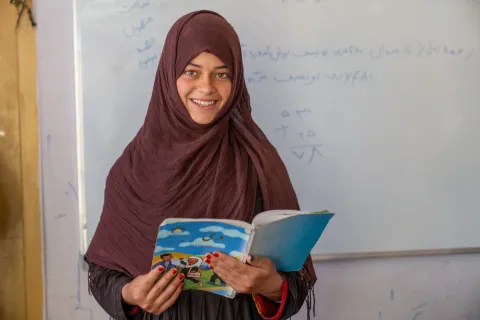
Making classrooms fun through playful and interactive learning
Lima applies new teaching methodologies in her lessons and enhances class attendance for girls in Afghanistan

“I always wondered how student performance in private schools is measured higher. What is it that private schools do differently?” says Sumbul Mohmal, school principal.
Sharing what she learned from a recent UNICEF-supported teacher training, she reflects, “Now we know – it is not only administrative tools like lesson planning, but also creative teaching methodologies. In just one month since the training, we have witnessed a five per cent increase in class attendance.”

An estimated 4 million children in Afghanistan are reported to be out of school. Many are unable to attend due to lack of proper school buildings, safe water and clean sanitation facilities, and lack of qualified teachers – particularly women. Children often drop out due to economic barriers, sometimes forced into child labour to help their families earn an income.
Lima is the class teacher for grade three girls at her school. She teaches all seven subjects to the same class, leading different subjects on different days. She will move with the girls through the grades, teaching them all the way up through grade six.
“I taught these girls when they were in grade two. Now I am with them for grade three, as well,” says Lima.

Lima began teaching soon after earning her bachelor’s degree, but had not received formal teaching education. She did her best but was not always a confident educator.
“When we first heard about the teacher training programme, we thought of it as a promising opportunity. We thought it would only present teaching methodologies, but it was much more than that,” says Lima.
While speaking, Lima oversees a learning activity, watching her students put a colourful chart on the blackboard that they prepared for the upcoming lesson.
“In our training, we learned to recreate and prepare materials that are inclusive and interesting for all students, despite their varying learning capacities and levels. My favourite activity is ‘guess what is on your bag’ and ‘onion circle’.”
“Before the training, we would prepare class assessments every week and assess every child individually. It was tiresome and added to the high burden of class management. The assessment games and activities I learned during my teacher training save me time; they are engaging and fun for the children and help improve learning,” says Lima.

With support from the Government of Japan and the Republic of Korea, UNICEF has trained teachers and teacher educators in several provinces in Afghanistan. Training modules including improved teaching methodologies, preparing lesson plans, inclusive learning, classroom management, and improving foundational literacy and numeracy.
UNICEF specifically targets female educators, as an increased presence of women as primary teachers helps improve school attendance for girls, as parents often feel it is more culturally appropriate for their daughters to learn from a woman.
“I have always liked naughty students, and never resorted to punishment of any sort,” says Lima.
“My training course reinforced my belief that naughty children are often very intelligent, they just need positive engagement and redirection. For students who are unable to perform, I work with them individually, and engage with their families to help them improve.”

“Primary education is a critical foundation for a child's life," says Lima.
"As teachers, we have a responsibility and an opportunity to shape these students into bright, positive and progressive adults who can contribute in building healthy societies and lives," Lima continues.
"Every student is my success. Seeing them succeed on their learning journeys makes me very proud."