Keeping hope alive in Afghanistan’s community classes
How UNICEF's partnership with the European Union brings pencils, notebooks, backpacks, trained teachers and more to classrooms in the remotest villages

"I don’t know how to read or write and because of this my life has been difficult," says Serajuddin. He serves as the head of the School Management Committee - or shura - in his village, Sharak Sabz, in Karokh district, western Afghanistan. "We want something better for our children."
Six years ago, drought and security concerns forced Serajuddin, his family and their neighbours to move from their home in Badghis province in western Afghanistan. Close to 400 families made Karokh in Herat their new home.
But at the time, there was no school in Karokh district. The nearest public school is more than five kilometres away; too far for children to attend.

For every child, a chance to learn
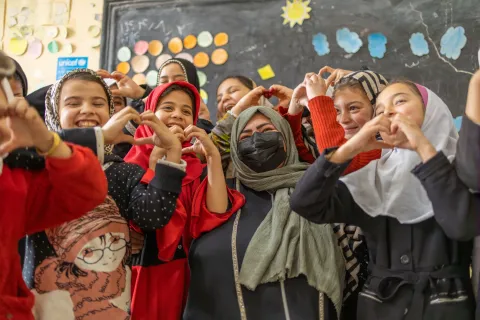
With support from the European Union Humanitarian Aid (ECHO), UNICEF established the first school in Sharak Sabz village. This ECHO-supported community class is 10-year-old Fatema’s only chance to go to school.
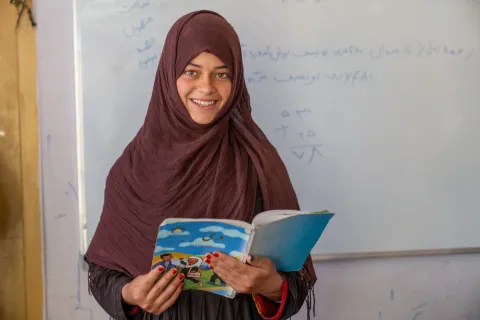
Also originally from Badghis, Fatema has learnt to read and write in the community class, which is just a 15-minute walk from her home. They have notebooks, textbooks, pencils, blue backpacks and, most importantly, a committed teacher.
For now, girls like Fatema are only able to attend school up to grade 6, as secondary education is still banned for girls in Afghanistan. But Fatema loves her teacher Rabia, and still hopes to become a teacher herself one day.

Community classes are common in Afghanistan, where public schools are sometimes too far or too full for children to attend, or where safety concerns and other restrictions prevent children from going to a public school. According to the 2022-2023 Multiple Indicator Cluster Survey, more than half of Afghan children do not attend primary school.
UNICEF's partnership with ECHO has helped improve the quality of learning for 9,500 students like Fatema, who are learning in 275 community-based education across Afghanistan, by bringing school supplies and trained teachers into the classrooms, as well as building capacity of local School Management Committees.

Where there’s a teacher, hope lives
Teachers are the heart of any classroom, bringing concepts and ideas to life for these curious young minds.
Fatema’s teacher Rabia loves her job. “Teaching is an acceptable profession in my community. It is likened to being a prophet because we show others the way. Because of this, my family is supportive of my work,” explains Rabia.

Rabia adds that she is an instant role model for her students, especially the girls.
“Most of them now want to become teachers because of me.”
Incentives for girls’ education
Female teachers are particularly important for girls’ education in Afghanistan, where only about 34 per cent of teachers are female, and very few of them are available to teach in rural areas. The limited presence of female teachers, especially in rural areas, where for cultural reasons, parents are reluctant to let their daughters be taught by male teachers, affects girls’ participation in school.

Rabia’s favorite subject is mathematics, which she had been studying in university before the ban on girls’ education was imposed. Under UNICEF's partnership with ECHO, Rabia has been trained in modern teaching methodologies. She now feels confident taking her 28 students through language, mathematics, religious and life skills classes.
Female teachers give girls like Fatema hope, something to aspire to as they navigate a complex environment with restricted opportunities for girls and women. And for many children, these schools are more than a place of learning, offering protection from child marriage, child labour and other forms of abuse and exploitation.
With additional funding from the Asian Development Bank, the World Bank, Global Partnership for Education, the German Committee for UNICEF, the Governments of Japan, Denmark and the Republic of Korea, UNICEF supports more than 15,000 CBEs across Afghanistan, enabling children like Fatema to learn and imagine a brighter future.