First-time students, lifelong lessons
Meet some of the teenage girls in Afghanistan in school for the first time, reclaiming lost years of primary education.

Adolescence can be awkward. It is a time of growth and change — a period of navigating new responsibilities and emotions, exploring identity, and adjusting to the world.
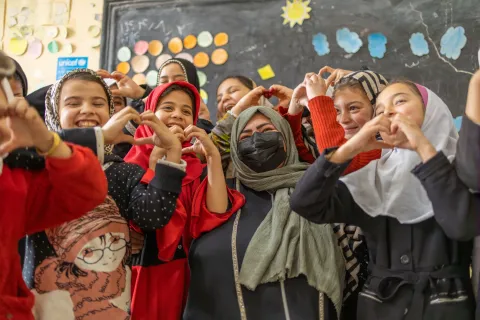
But for this group of teenage girls, the room buzzes with confidence and excitement. Although studying in grade 4 at an age when they should be in secondary, there is no space for insecurity in this class.
For the first time, they can pursue an education that was once out of reach.

Sakina, 16
Sakina's childhood was a story of an education interrupted.
She started school when every child normally does, but was forced to stop attending when her father relocated the family for work. In her new village, there were no nearby schools. Sakina had dreamt of using her education to uplift her community, but as she grew older, her ambition waned and her goals felt more and more out of reach.
"I used to attend school, but then we moved and the school was too far so I had to stop going," Sakina recalls.
"This new class is so useful for me. I learned to read and write; now I can find my way around town on my own."

She explains that before enrolling at the Accelerated Learning Centre, she was unable to navigate a world of written signs and instructions.
"I could not recognize which was the girls' toilet, or find the correct ward at the hospital," she said.
Between giggles, Sakina casts a conspiratorial glance at her classmate sitting beside her, their knees and elbows touching.
"I never had friends before because I was just at home all day." Sakina grins. "I love my new best friend Raihana because she is talkative and always smiling. She is a jokester."

Education on pause
Many Afghan communities are remote, with schools far from home, leaving parents uneasy about their children walking there alone. Coupled with limited road networks and no school transportation, attending school can be an impossible dream, especially for girls.
As years pass and restrictions on girls’ education in Afghanistan tighten, many have grown older but fallen further and further behind in their education, often making regular primary school an impossibility.
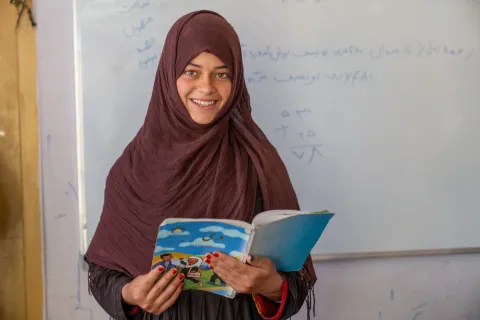
But Accelerated Learning Centres open a world of new possibilities. For the first time, these adolescent girls can sit together in a classroom. They flip through textbooks, solve equations on the blackboard, and call out answers to their teacher’s questions, excitement echoing through the room.

Raihana, 16
She appears a natural leader in the classroom. She is assertive and outspoken, wrangling her classmates into their assigned group activity, dispensing instructions without hesitation.
But Raihana's confidence is a new skill, one she has learned, nurtured and honed.
"I used to be shy," she says. It is strange to hear such a description from such a bold young woman.
"This class has made me more confident, and now my favourite thing is being here with my friends and classmates."
"I have learned how to respect others, accept each other's differences and personalities unlike mine."

Education accelerated
Enrolling one cohort at a time, Accelerated Learning Centres offer primary education for children who have missed out, and are therefore ineligible to enroll in their appropriate grade level in public schools.
The accelerated curriculum allows students to complete two grades per year, finishing grades 1 through 6 in just three years. Once the cohort graduates grade 6 in the centre, they are eligible to transition to grade 7 in the nearby public school.
UNICEF supports 3,500 Accelerated Learning Centres in Afghanistan, enrolling 107,000 children – 79 per cent of whom are girls.

"My parents never thought education was important... Now they are very serious about mine."
Fahima, 15
"I have six siblings: two sisters and four brothers. They are all older than me, and none have ever been to school."
Like many of her classmates, Fahima had never been to school before this Accelerated Learning Centre opened in her village. She has learned to read and write, and is the only person in her family who can.
"My parents never thought education was very important. Even when I joined this class, they thought I would not be able to learn anything because I missed too many years of school," Fahima explains, appearing jubilant that she has proved them wrong.
"But now they are very serious about my education," she continues. "I can read all correspondence for them. I help find addresses and locations for my mother, and identify names and phone numbers in my father's phone."
Fahima beams. "My family has seen I am learning and they are so proud of me."