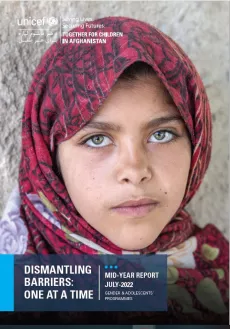
Dismantling barriers: One at a time
Gender & Adolescents’ Programs Afghanistan
About
Almost one year since the Taliban took over, Afghan women continue to encounter a perilously difficult set of challenges to their basic rights including with respect to non-discrimination, education, work, public participation, health, including sexual and reproductive health.
Women and girls are being systematically punished based on their gender.
They are subject to restrictive policies which prevent them from taking a proactive role in society. Taliban has also imposed sweeping restrictions on the rights to freedom of expression, association, assembly and movement for women and girls. On 17 May 2022, the DFA dissolved the Afghanistan Independent Human Rights Commission, cutting off a crucial source of support for Afghans facing violations of their human rights, including women and adolescents (girls and boys) experiencing gender-based violence.
The latest decrees by the Ministry of Hajj and Religious Affairs on the restriction of dress and movement eliminates any chance for women who head their households to work and earn a much-needed income to feed their families. This is not only threatening to their rights but is also exacerbating further food insecurity and starvation. In regard to education, the authorities have denied the girls access to secondary and tertiary schooling, which robs them of the opportunities given to their male counterparts. According to the UN Women Gender Report No. 2: 2022, suicides rates among women have reportedly increased and mortality rates, including maternal mortality are expected to rise.
Contrary to prior commitments, on 23 March 2022, the de facto authorities announced that secondary schools would remain closed to girls. No meaningful steps have been taken to reopen secondary schools for girls to date. These restrictions directly and systematically exclude 1.1 million girls from secondary education. (Afghanistan Education Cluster. 2022. Back to School Situation Update: April 2022)
New analysis by UNICEF has found that depriving girls in Afghanistan of their right to secondary education will have a devastating effect on the country’s economy, as it already created a loss of at least US$500 million for Afghan economy in last 12 months.
The combined effect of gender-segregation requirements and a lack of educated women will be far-reaching, shutting women out of public life, access to services, knowledge. Keeping girls out of secondary school costs Afghanistan 2.5% of its annual GDP, and overall economic losses due to the erosion of women’s employment are estimated at up to USD 1 billion (5 percent of GDP).
Child and forced marriages have increased in the past year despite a decree issued by the de facto authorities in December 2021 opposing forced marriage. Drivers include economic pressure, lack of educational and professional prospects for girls, and the reported practice among Taliban officials of forcibly marrying women and girls themselves, which leads families to pre-emptively marry off their girls and women. Girls who are forced into marriage face increased risk of GBV perpetrated by their husbands and in-laws, as well as limitations in accessing reproductive health, and lower levels of completed education. (Amnesty International. 2022. Death in Slow Motion: Women and Girls Under Taliban Rule)
The justice system has in large part been dismantled, to the disproportionate disadvantage of women and girls. Access to justice for women and girls in this context is almost non-existent. Court cases of family law and violence against women are being increasingly diverted to informal justice mechanisms. Between August 2021 and June 2022, the UN Assistance Mission in Afghanistan (UNAMA) received 87 reports of violence against women and girls, including two honour killings, none of which were processed through the formal justice system. It is understood that there is currently significant underreporting of violence against women and girls due to data gathering limitations, barriers to reporting, and an increasingly permissive environment. (UNAMA. 2022, Human Rights in Afghanistan: 15 August 2021 – 15 June 2022. Kabul).
Afghan women and girls played a pivotal role throughout the history of their country. It is essential they continue to play this role and their rights are protected. UNICEF stands firmly with the women and girls of Afghanistan in these difficult times, and we remain committed to supporting their safety and their full and free participation in the social, economic, and political life of the country.