
Conflict and Peace Analysis Tool 4
Sample Conflict and Peace Analysis Tools
Purpose
Conflict and Peace Tool – This Tool complements the CPA Tool 3 – Age and Gender Sensitive WASH Conflict and Peace Scan, and includes a selection of easy-to-use visual tools that can be applied by staff to facilitate interactive conflict analysis processes, internally within teams, with partners, and with participating communities as relevant.
They are easily adapted and conducive to facilitate discussion – and can be used with diverse groups due to their simple and visual methodologies. The tools have been selected for their conduciveness to directly feed into either a stand-alone or a preparatory Peace and Conflict Scan (CP Scan).
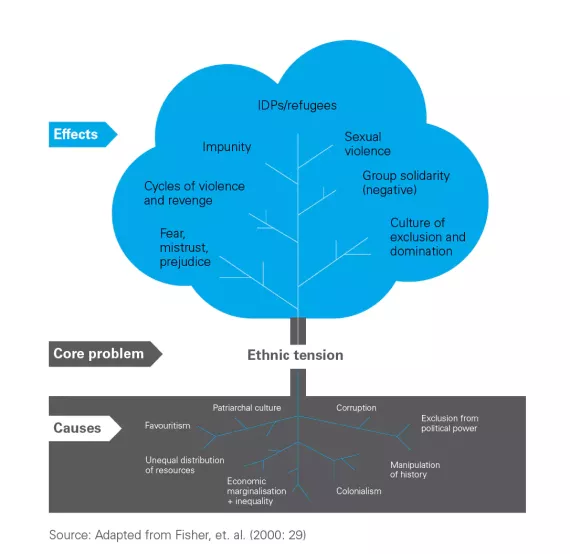
Conflict Tree (example Conflict Dynamics in Burundi)
Purpose
To identify key conflict issues and understand the underlying causes and effects.
The Basics
The conflict tree works with one or more core problems, and then identifies the root causes, and the effects of the problem. Effects are the current (or past) manifestations of the conflict: what do we see, how are people affected, what patterns can be observed? Causes are long-term structural issues, underlying factors that result in the conflicts. This can be a first step in conflict analysis – Use this when you need a simple tool to provide the basis for discussion within a programme team or among stakeholders. This exercise is best done by a group in a workshop setting. Draw the tree template, give participants post its or cards, ask participants to write or draw relevant factors, and ask them to post it in the ‘right’ place in the Tree – discuss as a group were to place the factors as causes, or effects and why.
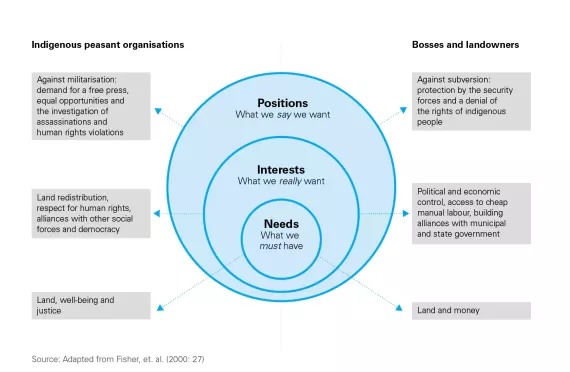
Stakeholder Analysis – Position, interest and needs (example from Chiapas Mexico)
Purpose
To understand conflict parties and their relation to the conflict, including motivations and logic of each group, and identify the power dynamics among the parties.
The Basics
This is a simple tool for developing a conflict profile of strategic conflict stakeholders. You may list the primary (directly involved), secondary (interested), and tertiary (affected) parties, and then identify for each their stated (public) positions or demands, the interests that lie behind those demands, and the basic needs that might be involved. This is the first step of a stakeholder mapping – first understanding each conflict party before moving on to analyse their interactions with each other and with the conflict.
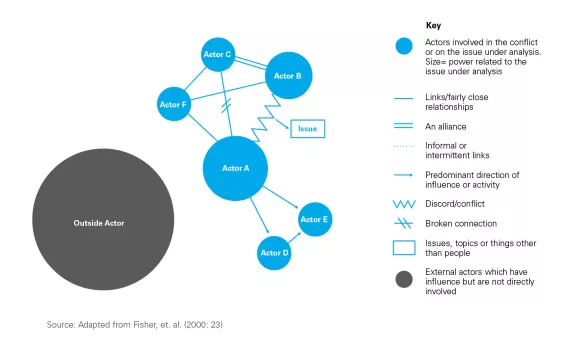
Stakeholder Mapping
Purpose
To better understand the relationships between parties, identify where power and influence lies, to see who might be potential allies or ‘spoilers’.
The Basics
A tool for graphically showing the relative power/influence and relationships among the parties in conflict. Stakeholder mapping is a technique used to represent the conflict graphically, placing the parties in relation to the problem and in relation to each other. If people with different viewpoints map their situation together, they may learn about each other’s experiences and perceptions. It is important to place the intervener (e.g. UNICEF, partner) in the map to identify potential interactions and influence in support of conflict-sensitive programming.
Conflict Timeline (example from Liberia)
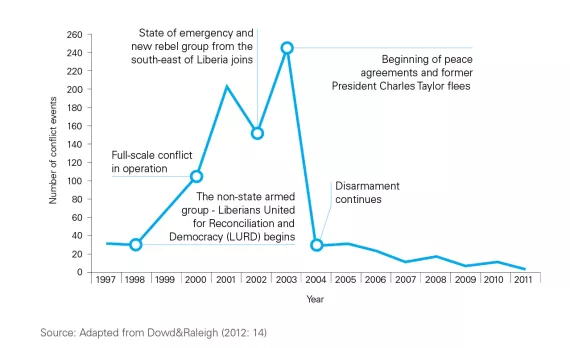
Purpose
To visualize the ‘history’ of a conflict, to identify patterns to a conflict, that may help to identify future trends including recurrent triggers or dynamics that have led to de-/escalation.
The Basics
You can use a simple arrow as a timeline and ask participants to brainstorm and ‘plot’ key conflict events (positive/negative) since the start of the conflict. You may add a ‘severity’ scale to determine ‘spikes’ in a graph as illustrated, in relation to your choice of relevant dimensions of the conflict – e.g. impact on WASH, number of displaced, number of casualties. If you are using the tool with conflict parties, you may ask them to draw their own individual timelines and compare their ‘conflict narratives’ to discuss similarities/differences and enhance an understanding of the others’ perspectives
Resource BoxMore details about the tools included and additional ones can be found in the following resources:
|


