Home nurse visits ensure health care for families in Ukraine
Nurses trained under the UNICEF Home Visiting Programme continue to visit families in the frontline areas, providing vital care and support

- Українська
- English
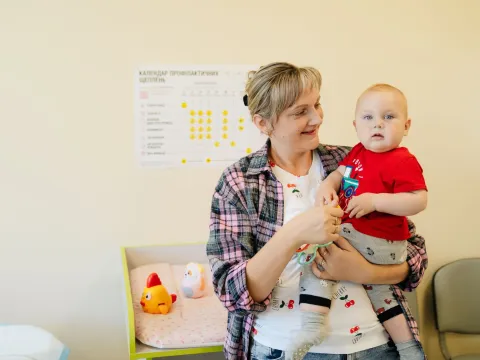
Nurse Alina is always welcomed into Valeriya’s home in Kramatorsk, Ukraine. She has been providing home visits for the family for 19 months, ever since Valeriya gave birth to her daughter Myroslava. During the first month of the baby’s life, Alina came every week to help the young mother with breastfeeding, bathing and vital information.
"We brought the baby home from the hospital and put her in a crib with a small pillow,” recalls Valeriya. “We learned from Alina that we shouldn't have done that because it could affect the baby’s head.”
Alina underwent special training for nurses under the Home Visiting Programme initiated by the United Nations Children's Fund (UNICEF). As a result, she received a certificate for her competence in organizing childcare for babies from birth to three years.

For the first month of a baby’s life, nurses like Alina visit at least three times. At the age of two months, visits reduce to once per month. If a child is diagnosed with developmental or any other social or psychological risks, an individualized family visitation plan is developed.
In particular, Alina receives many questions on breastfeeding and vaccinations.
"A visit can last from one to three hours,” explains Alina. “I make sure to take all the necessary measurements, such as chest and head circumference, and weigh the baby. I also tell parents about vaccinations, rickets prevention or sudden infant death syndrome, which, for example, occurs when parents put newborns on their tummies and they suffocate. We always draw the parents' attention to this, leave them with memos on infant care and show presentations on tablets provided by UNICEF."

Support amid the war for both children and parents
Primary Health Care Centers (PHCs) in the Donetska region were among the first to join the home care nurse training programme in June 2021, when the first sessions for nurses and doctors were held. Today, amid the ongoing war, home visits have become even more valuable.
"Now, families with little children don't usually want to leave home and go to the doctor,” says Alina. “This is why home visits provide important support for families amid the war.”
Nurses have started to pay particular attention to the mental health of both children and parents.
"Very often, mothers of newborns stop caring about themselves, as they may have postpartum depression or eating disorders,” says Alina. “We pay attention to this and help to eliminate such risks for the woman and, accordingly, for her child.”

Since the outbreak of the full-scale war, special protocols have been developed. Nurses tell parents how to act during different situations, such as attacks or air raids. And thanks to funds from UNICEF and donations from people in the Netherlands, the outpatient clinic in Kramatorsk has also received a car that helps them to organize home visits.

"Parents and their children are a very sensitive segment of the population, who have a strong reaction to the sounds of explosions or sirens," says Yevhen Yatsura, head of the outpatient clinic in Kramatorsk. "Living during the war can affect their mental health. That's why the support of a nurse is so important right now."
The Home Visiting Programme is a joint project of the Ministry of Health of Ukraine and UNICEF which aims to implement a universal and progressive model of home visits to improve the provision of medical and social care to families with children aged 0 to 3 years in the primary healthcare system.
The programme is currently being piloted in the Donetska, Zhytomyrska, Kirovohradska, and Kyivska regions. In 2023, it will be expanded to seven more regions of Ukraine, including Vinnytska, Dnipropetrovska, Lvivska, Odeska, Poltavska, Rivnenska and the city of Kyiv.