How workplace engagements are preventing the spread of COVID-19
“Although people know about COVID-19 today, we must continue sensitizing them,” Nanzige.

There is an estimated 3.4 million people who live or work in Uganda’s capital Kampala. The majority of these work in informal places such as vendors’ markets and live in informal settlements. A visit to Nakawa Market, less than 5km east of Kampala’s central business district is for the brave.
“Faasi Faasi,” a young man with sweat flowing from his clean-shaven head shouts while pushing a wooden cart with about a ton of raw Matooke — Uganda’s favourite food. If you fail to give way, you risk being knocked down. The pathway is narrow, uneven and slippery when wet.
As you look for space to give way, another young man mentions the same words. He is carrying on his head a bale of used clothing probably weighing 100kg or so. This is the definition of hustling.
On each side of the pathway is a lady selling fresh beans and cowpeas. Any tripping would spread them on the ground. Walking in Nakawa Market is not for the fainted hearted. It is akin to walking a tightrope over the Niagara Falls at full speed.

Soon, Catherine Nanzige comes into view. Standing under a makeshift canopy that is due for replacement, Nanzige is taking a vendor through COVID-19 prevention guidelines using a coloured flipchart. Encouraging the vendor to always have her mask on and regularly wash hands with soap.
Nakawa Market is back to full capacity after the partial lifting of the lockdown. As many as 10,000 vendors are estimated to work in this informal market every day. More people come in as buyers on a daily basis. Farmers bring in produce and other goods from all over the country and sometimes, depending on the season, from neighbouring Kenya. Kampala’s 3.4 million people must be fed.
This can easily be the epicenter of a highly contagious disease like COVID-19. But Nakawa Market just like Wandegeya Market, at the foothill of Makerere University, the country’s premier learning institution, COVID-19 didn’t create such a menace as one would expect.
This was because World Vision International with UNICEF support quickly enrolled some vendors into a training on COVID-19 prevention through the enhanced risk communication and community engagement to improve compliance to prevention and mitigation measures in 12 districts, thanks to funding from the Swedish International Development Cooperation Agency (SIDA).
Nanzige is one of those vendors and market leaders who volunteered to be trained so they could mobilise fellow traders against the disease through prevention.
“During the first lockdown, nobody wanted to believe us because nobody was suffering from COVID-19. After the second wave, people started believing us,”
“Although people know about COVID-19 today, we must continue sensitizing them,” she adds.
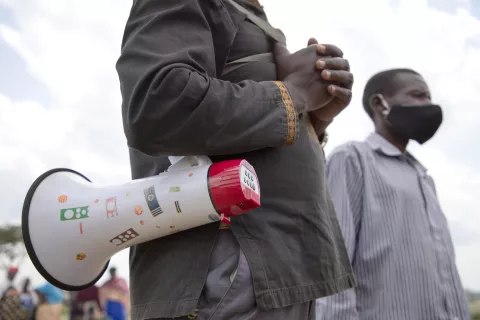
Nanzige knows the limitations of reaching 10,000 vendors individually who will stop listening the moment they see a potential customer. So she is working with Julius Kibirige whose rich baritone is sending the message to a larger audience through a megaphone.
“Workplace sensitization is key in preventing the spread of COVID-19 because of the close proximity of many people who spend many hours of the day together yet live in different parts of the city,” explains Patrick Kirunda, the Senior Health Inspector at the Kampala Capital City Authority (KCCA). “Many workplaces adhered to our messages of prevention and implemented standard operating procedures such as social distancing,” he further explains.

A few kilometres from Nakawa Market is an industrial area where warehouses stand in endless rows. One such place is Kampala Pharmaceutical Industries (KPI).
Before the training, workers used to move to a nearby restaurant for meals where they mixed freely with the community. With COVID-19 spreading at supersonic speeds, one of the warehouses was turned into a canteen to ensure that staff can practice social distancing.
“Staff use the canteen in turns to avoid overcrowding,” says Emma Amau, KPI’s head of security and one of the workplace COVID-19 compliance officers. “We take temperature readings three times a day and we have a medical rescue partner that comes in should anyone have a high temperature,” Pamela Aliru, the Production Supervisor (in charge of safety) adds.
With vaccination now a top strategic focus in the COVID-19 response, people like Nanzige and Amau have also found something else to add to the previous messages to convince some of the most sceptical people that COVID-19 vaccines are safe. “Our Chief Executive Officer went with factory workers at Naguru Hospital for his COVID-19 vaccine. That quickly spread to all the workers and eased our job. We no longer explain much leading to increased uptake of the vaccine,” concludes Amau.