

A Lifeline Restored
When Cyclone Ditwah left communities without safe water, timely support from the people of Japan helped restore essential water systems and strengthen resilience.

When Cyclone Ditwah unleashed torrential rains and landslides across Sri Lanka's central hills, it did more than take away lives, damage homes and roads. Across Sri Lanka at least 538 community-based water supply schemes were impacted, cutting off essential potable water to affected communities.
In Garandiella village in Ramboda, a remote village in Sri Lanka’s hill country, Ditwah severed a lifeline. Overnight, the community's water supply system was destroyed, leaving 72 families, nearly 280 people, without safe water.
For two days, taps ran dry. Families scrambled to find water wherever they could, while community members worked tirelessly to patch together a temporary solution. But they knew it was only a matter of time before the damaged system failed again with the continuing rains.
With funding from the Government of Japan, UNICEF supported the rehabilitation of the village's community-based water supply system, replacing damaged pipelines with new PVC pipes and restoring the network that families depend on daily. The intervention also prevented a looming crisis, as the system's storage tank had cracked during the disaster and risked collapsing completely.
“The heavy rains completely destroyed our water supply system,” recalls S. S. Senarathne, Vice Chairman of the village community-based water supply committee, which manages the scheme. "We managed a temporary repair soon after the rain, but without this support it would have been really bad. We spent two days without water, and the storage tank cracked. If it had broken, it would have been another disaster for the village."
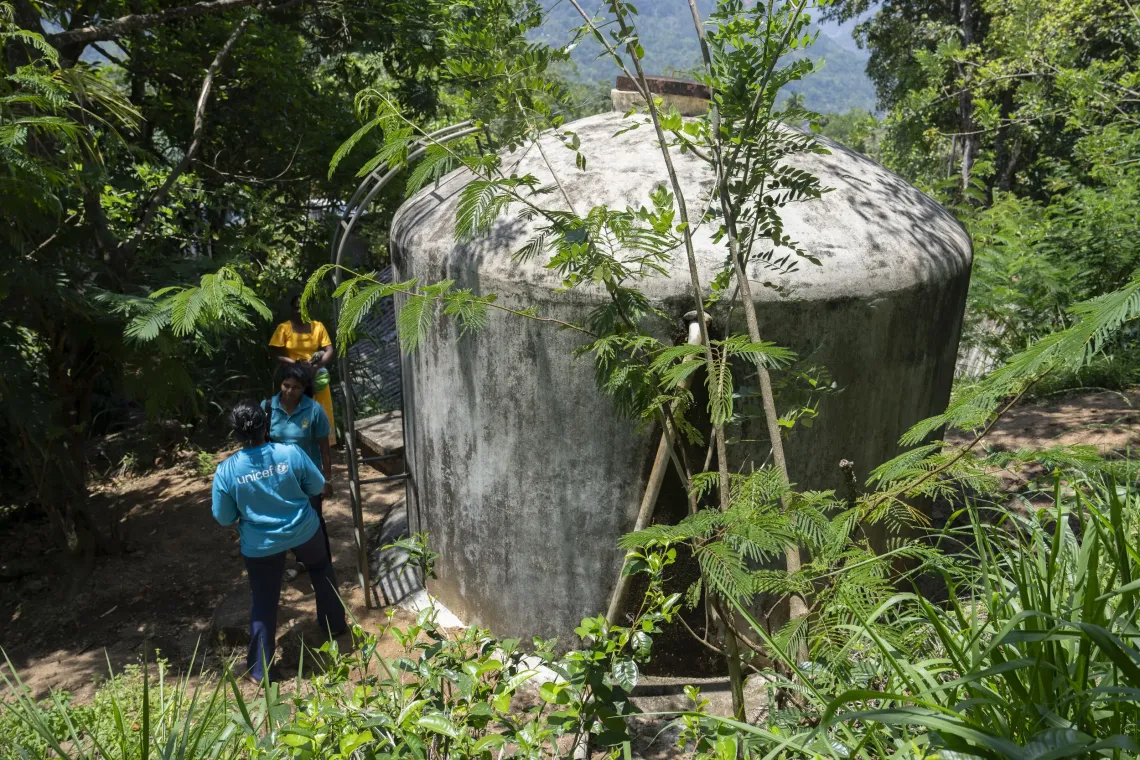
For a community that has managed its own water supply for years, the rehabilitation restored a sense of security with the chaos and instability the cyclone brought with it. Families no longer have to worry about whether water will reach their homes each day, allowing them to focus on rebuilding their lives after the disaster.
The same story unfolded hundreds of kilometres away in Sabaragamuwa Province, where the Mabopitiya community-based water committee provides water to approximately 115 families, benefiting nearly 400 people.
In this rural village too, landslides ripped through the community-managed water system, destroying almost all of the galvanized iron (GI) pipelines. The committee did what it could, but temporary repairs were the only option within their limited resources.
"Landslides destroyed almost all of our GI pipelines, and we could only manage and afford temporary repairs to the supply system," says R. M. Wijeyabandara, Secretary of the Mabopitiya Community-Based Water Committee.
For some families, those temporary repairs were not enough. Nearly 25 days passed without a reliable water supply. Every morning meant walking 1-2 kilometers uphill, carrying heavy cans of water. The journey was exhausting, and even then, clean water was never guaranteed.
"Our wells had dried up, and not all the available water was potable," Wijeyabandara explains. “People had no choice but to walk long distances to collect water.”
With support from the people of Japan, UNICEF rehabilitated damaged sections of these community-based water systems, helping restore safe and reliable access to water for hundreds of families.
This support was provided as part of the Humanitarian Priorities Plan activated by UN in Sri Lanka to respond to the immediate needs of communities and families affected by Cyclone Ditwah. Close to 29 water supply schemes were rehabilitated with this support across Sri Lanka. Beyond rebuilding infrastructure, the support strengthened community resilience by ensuring that locally managed water systems could continue serving families long after the immediate emergency had passed.
Today, water flows once again through Garandiella and Mabopitiya. Children can attend school without worrying about collecting water before class. Parents are able to focus on rebuilding their homes and livelihoods instead of searching for the next safe water source. After the devastation of Cyclone Ditwah, restoring water has meant restoring something just as vital; the hope that communities can recover, rebuild and face the future with confidence.
