

Beyond the Boundary Line:
How Sports is Shaping Futures in Ampara
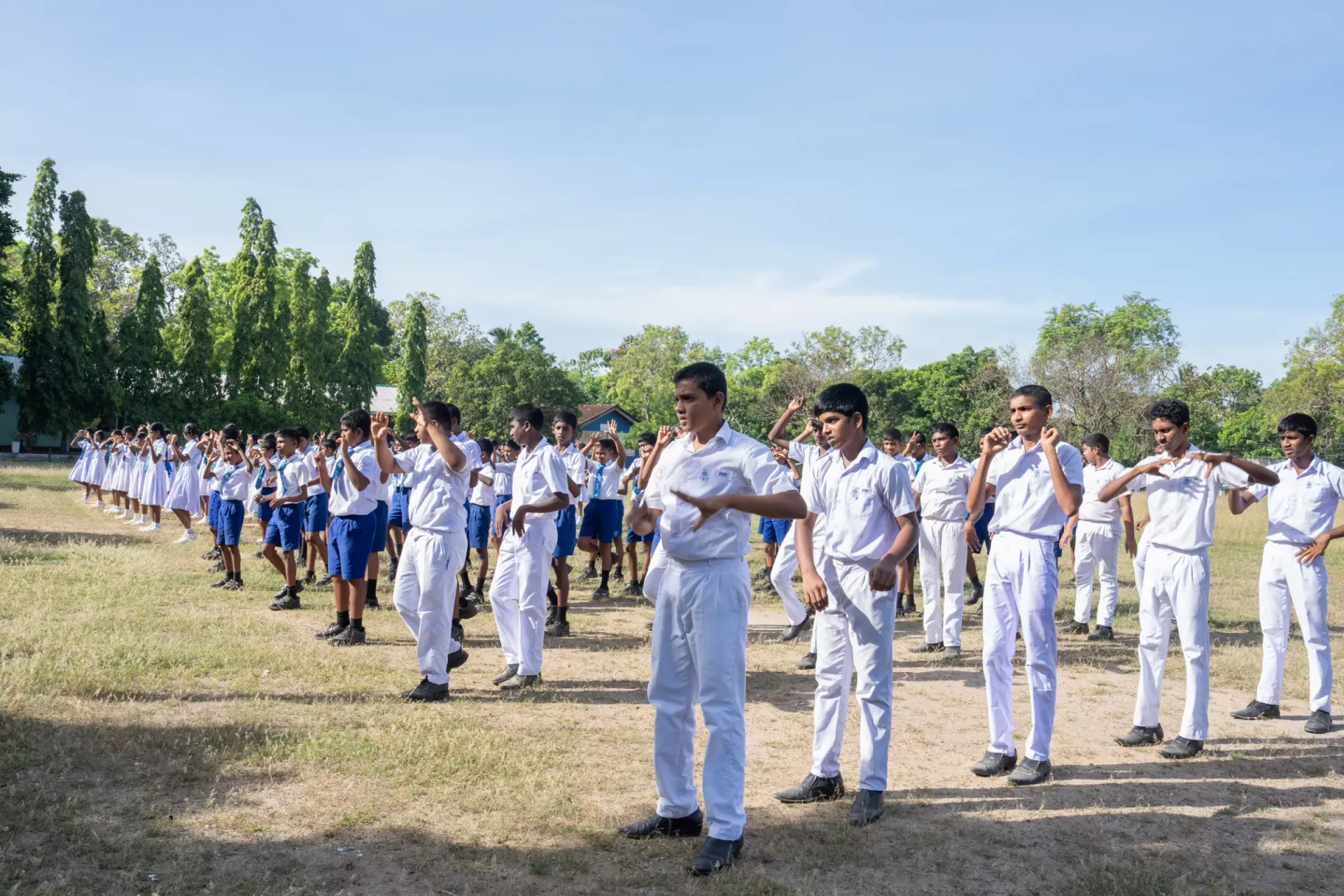
As the first rays of sunlight filtered through the misty morning in Ampara, the grounds of Hegoda Sri Indrasara Vidyalaya were already abuzz. A bell rang, and with surprising precision, rows of children began forming neat lines in the open area for the morning assembly. It was not with the usual monotony, but with something extraordinary; the students led the session, confidently switching between Sinhala, Tamil, and English.
This wasn’t just another school day. It was a window into witnessing how something as simple as sports had sown the seeds of transformation in this school in Sri Lanka’s Eastern Province. From personality development to academic improvement, the Sports for Development (S4D) programme supported by the Australian NGO Cooperation Program via Australia's Department of Foreign Affairs and Trade (DFAT), has redefined the meaning of education for these children.
After the assembly, the students didn’t scatter. Instead, they picked up brooms and baskets and began tidying up the school premises. They worked as one, helping one another. “Caring for the environment has become part of who they are,” said the school principal, Sepalika Kumari with pride in her voice.
“This isn’t just a sports programme. It’s a way of life that has made the children more energetic, more considerate, and more driven.”

From Empty Fields to Full Hearts
Hegoda Sri Indrasara Vidyalaya lies close to Ampara town, but until recently, it was miles away in terms of opportunities. Facilities were limited, sports were a forgotten subject, and many children were on the edge of dropping out. That changed when the S4D programme was introduced.
Implemented by UNICEF in partnership with the Eastern Provincial Department of Education and the generous support of UNICEF Australia, the S4D initiative uses the power of sport to promote learning, social inclusion, and emotional well-being.
It goes far beyond physical activity, offering children new ways to develop life skills, stay engaged in school, and discover their full potential both inside and outside the classroom.
Under the programme, girls’ cricket teams were established both in schools and through children’s clubs, and cricket equipment was provided in a bid to promote gender inclusivity and equality. Additionally, teachers were trained to integrate sport and game-based learning into daily school activities to enhance students’ soft skills. Personality development workshops and adolescent programmes were also conducted to foster gender inclusivity and strengthen social cohesion.
“Earlier, sports weren’t a priority,” says physical training teacher Bhashini Rajaminindoru. “But this programme transformed our students. We now have teams for cricket, netball, and volleyball. Kids who never spoke up are now taking the initiative and it has helped bring back those who were losing interest in school,” she adds.
14-year-old Menuwan Nethsara, a quiet boy who was once prone to anxiety and outbursts, is one such student. Menuwan never imagined himself playing any kind of sport. “I was just not interested. I only joined the practices to make the PT teacher happy,” he admitted, smiling shyly. “I had temper issues and always felt uneasy. But now, I feel calmer. I’ve started leading school activities. I feel excited about the future.”
His transformation isn’t an isolated case. In primary classes, lessons in mathematics and literacy are now taught using games and physical activity. It’s an approach that has made learning joyful and memorable. “Their eyes just light up when they learn through play,” said one of the class teachers. “They’re not just learning faster, they’re happier.”

Confidence in Every Step
For 14-year-old Gothami Dilthara, the programme helped her find her voice. “I used to feel shy and not so confident in myself,” she said. “But after joining the sports festivals and the adolescent empowerment programmes, I feel my confidence has improved. I can juggle schoolwork and extracurriculars and now I wake up looking forward to the day.”
The programme's youth engagement components are tailored to help students discover their strengths outside the academic realm through group discussions, role-playing, group projects, and physical challenges that demand leadership, resilience, and cooperation.
“It’s these recreational sporting activities that also support building real character,” noted Bhashini. “Children are learning life skills that no textbook can teach.”
The ripple effects have reached families too.
Dulani Nadeeka, a resident of Mihindupura and a mother whose daughter was struggling with self-esteem, shared her story with emotion.
“My daughter was always worried about her weight. She didn’t want to take part in anything, and it broke my heart. But the teachers gently encouraged her to join the youth engagement sessions. She left the house saying she didn’t want to go… but she came back different,” Dulani recalled. “Now she’s a track and field athlete. Her confidence has soared, and she’s even more focused on her studies.”

Building a Cohesive Future
One of the programme’s most compelling aspects is how it has fostered inclusivity and social cohesion in a region often defined by its diversity. Ampara, home to a mix of ethnic groups; Sinhalese, Tamils, and a Muslim majority, has long been a reflection of Sri Lanka’s multicultural identity.
Despite its complex history, communities here have found ways to live in harmony, and the S4D programme has only strengthened these bonds among the younger generation.
While the school primarily uses Sinhala as the medium of instruction, the trilingual morning assemblies symbolize mutual respect and unity.
In a country still healing from the wounds of ethnic tension, these seemingly small gestures such as children leading events in three languages and youth engagement sessions composed of students from all backgrounds, serve as quiet yet powerful reminders of what harmony looks like.
The youth engagement sessions also played a vital role in broadening children’s social horizons. Through these activities, they not only get the chance to travel outside their community but also meet peers from different ethnic and cultural backgrounds and interact in safe, supportive environments.
Many of them, for the first time, mingled freely with children who spoke a different language or came from different traditions. During these meet ups, they break stereotypes and build friendships.
“Sport has become the common language here,” said Principal Sepalika. “Through S4D, we’ve built bridges between ethnic groups as well as between our children and their own potential.”

More Than a Game
It’s tempting to look at S4D programme through images of cricket, but what’s happening at Hegoda Sri Indrasara Vidyalaya goes far beyond that. It’s about nurturing emotionally intelligent, socially responsible, and academically engaged individuals.
“These children are now thinking about their futures,” Bhashini said. “They have learned how to lead, how to care and how to work as a team. They’re excelling in school as well as becoming kinder, more thoughtful members of society.”
Indeed, the boundaries they’ve crossed aren’t just physical. They’re the invisible ones; shyness, fear, self-doubt, social divides, that often hold children back as much as poverty or limited resources.
A Lesson for All
As the school day at Sri Indrasara Vidyalaya unfolds, we saw more than just children playing. We saw young minds learning to take charge of their own lives and a community that has learned to invest in its future. We also saw a powerful truth come alive: when sport is paired with intention, compassion, and education, it becomes a catalyst for deep and lasting change.
Perhaps Menuwan said it best, when he reflected on how far he’s come.
“I feel like I have something to look forward to,” he said, with a volleyball in his hand. “I’m not just playing a game. It's made me feel like I can confidently steer my future.”


