Protection against malaria: at the heart of the prevention campaign
-

In the south of Madagascar, Fort-Dauphin accounts for more than half the cases of malaria recorded in the Anosy region. To help the population cope with this disease, a prevention campaign has been launched there.

In December 2023, seasonal malaria is rampant. Narindra Herifenitra, midwife and head of the level II basic health centre in Ampasy Nahampoana, is overwhelmed. For the past few weeks, she has been seeing more than 75 patients every day. The majority, like Martino, who has put his head on his arms, have tested positive for malaria and require treatment.

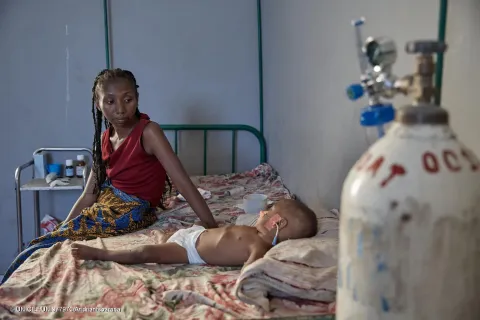
This is also the case at the Manambaro basic health centre, where 5-year-old José was recently transferred. He has severe malaria after several days of self-medication. The little family lives more than two hours away by foot from the centre. Their visit was purely by chance, as the family had referred another family member who was ill.

At the Analandravy basic health centre, the pharmacy doubles up as a consultation room, with so many patients pouring in. Tohizara, aged 3, and her little sister are waiting their turn, accompanied by their mother and grandmother. They will both be diagnosed with malaria.

To combat this serious situation, a four-day chemoprophylaxis campaign to prevent seasonal malaria is being held across the district. It will be repeated three times, until March 2024, to protect children aged between 5 and 14. At the Ankaramena basic health centre, Deux Cents Premier, a 30-year-old community worker, has just received his forms, register and medication.

All these supplies have been made available thanks to financial support from the UN Foundation to UNICEF, which made it possible to deliver them to basic health centres. The chemoprophylaxis campaign to prevent seasonal malaria involves the intermittent administration of a preventive dose of drugs to provide immunity over a given period. It is renewable over three or four months.

All the community workers have also met, exchanged information and received the latest guidelines to begin home visits and the distribution of the medication.

Marcia, one of the community workers, has decided to go door-to-door. At the home of Rosine, a mother of six children aged between 6 months and 11 years, she explains in detail the various stages involved in taking the different tablets. Mandova, the eldest, is the first to take them under her watchful eye.

Deux Cents Premier and his partner have opted to hold a meeting with the families under the palaver tree. They fill in the forms for each child and the tablets are administered in their presence.

The community workers are also accompanied by UNICEF field teams who check that the campaign is running smoothly. It is a time for exchanging and sharing information, to convince people of the importance of the campaign and reassure them that local care is available.

The second round of the chemoprophylaxis campaign to prevent seasonal malaria was held at the end of January 2024. Parfait, aged 6, was one of the first children to be made aware of the campaign in the first round, and took his tablets when community workers visited his village in Ambaniala, in the commune of Ampasy Nahampoana.