Transforming lives: Tests and Smiles That Light Up the World
Supporting an inclusive and sustainable future

During emergencies, children with disabilities face unique needs that must be addressed to ensure their protection, comfort, and well-being.
For six-year-old Candy Odhiambo, the recent floods in Kisumu County presented additional strife and strain on her parents’ pockets as they tried to get her a new pair of spectacles to improve her vision.
Candy’s vision was corrected during a recent outreach program in Kisumu County. Her bright, wide smile lit up her face, showing off her brand-new frames.
With the new pair of spectacles on her face, Candy smiles and plays near her father, embracing this fresh addition to her look. The spectacles bring everything into focus, including his father's smiling face, and she is excited that everything she sees around her is more precise.
As the world observes the International Day of Persons with Disabilities, this year’s theme, “Amplifying the Leadership of Persons with Disabilities for an Inclusive and Sustainable Future,” highlights the importance of inclusion.
It emphasizes the need to empower children like Candy, ensuring an inclusive and sustainable future.
Her father, Eric Odhiambo, explains that, with the prevailing hard economic times, he has been saving earnestly to purchase the spectacles but has yet to progress due to a strained family budget. A recent humanitarian emergency response gave the grade one pupil hope, allowing her to see clearly for the first time in months.
"When I took Candy for her first eye test, I was asked to pay Sh 40,000 for an appropriate pair of spectacles. I couldn't afford it. She got her first pair of glasses during the outreach today," said Odhiambo.
In Kenya, families with a child or adult with disabilities face significant disadvantages. Families with a child with a disability are 9% more likely to experience multidimensional poverty, and 92% of caregivers need financial support, with 48.1% needing assistive technology for care. Full-time caregiving often limits income-earning, with unpaid care disproportionately affecting women and girls.
Erick Ogolla appreciates the UNICEF-supported humanitarian program; his daughter's vision has finally been corrected. During the eye assessment, the underlying sense of attention on Candy's vision reassures him that the long-standing problem will be solved. Ogolla says that since childhood, his daughter has struggled, and the current tests were to address the unique visual challenges associated with albinism. Uncorrected vision problems can affect a child's ability to read, write, and engage in everyday activities, leading to developmental delays.
"I am happy that my daughter's vision has been corrected, and we anticipate that her school performance will improve too," said Odhiambo.

UNICEF Social Protection officer Nahashon Njuguna notes that the partnership with the State Department of Social Protection and the National Council of Persons with Disabilities seeks to address gaps in data, systems, and solutions that hinder children with disabilities and their families in humanitarian crises and emergencies.
Njuguna explains that the goal is to understand the child's proper support and service needs by designing humanitarian response interventions for children with disabilities through the Humanitarian Innovation Programme for Children with Disabilities.
"Through different partners, we support children and persons with disabilities by conducting needs, medical, and education assessments and issuing disability certificates," said Njuguna.
Parents appreciated that the assessment guided proper educational placement for children with disabilities.
George Odhiambo, County Coordinator of the National Council for Persons with Disabilities noted that children with disabilities are enrolled in schools that are not disability-friendly because the parents are not aware of what type of schools the children should go to.
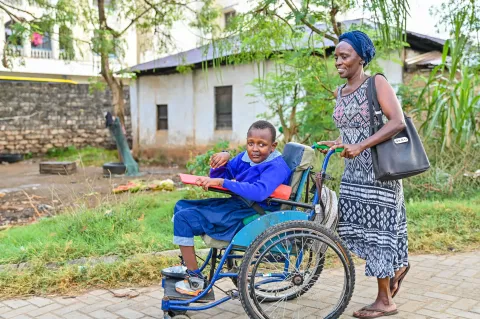
“This is a journey of hope. Please don’t hide your children with disabilities,” said Monica Kirera, mother to 8-year-old Kylan. “Raising a child with a disability comes with unique challenges, especially for full-time caregivers, but support and understanding can make all the difference.”
“It hasn’t been easy raising Kylan, a child with cerebral palsy, but today, I accessed seamless services through the e-Citizen platform. These include education placement, assistive devices, occupational therapy, and a disability certificate,” said Monica.
"The journey hasn't been easy as a mother because you must be at home throughout. It would be best if you resigned from your formal work to be home with the child," she said.
Other challenges include the need for medication, doctors' availability, therapy availability, assistance, and assistive devices. The parents expressed their gratitude for the professional help and timely consultations.
"The level of expertise is exceptional, and the assessments were conducted efficiently. The education placements offered were both insightful and supportive," she said, adding the certificates were issued through the government portal, E-citizen.
In crisis settings, children with disabilities face more significant barriers to education due to inaccessible learning centers, untrained teachers, and a lack of assistive devices. In Kenya, only around 10% of these children attend school regularly, and this rate drops further in emergencies due to displacement, poverty, and structural challenges.

Odhiambo further noted that families with a child or adult with a disability remain highly disadvantaged – they are significantly more likely to experience poverty and face a wide range of barriers to accessing services, especially during emergencies.
Odhiambo added that children with disabilities in humanitarian settings face significant barriers that hinder their access to health, education, and social services.
"These multifaceted and deeply rooted barriers pose urgent challenges that require immediate intervention and limit the opportunities for children with disabilities to achieve their full potential and lead dignified lives," said Odhiambo.
In 2008, Kenya committed to the Convention on the Rights of Persons with Disabilities (CRPD), which emphasize the inclusion and protection of children with disabilities in all settings, including emergencies. Despite the gaps, the 2018 National Action Plan for Disability-Inclusive Disaster Risk Reduction highlights Kenya's efforts to incorporate disability into emergency planning. Barriers must still be overcome due to insufficient resources, training, and crisis awareness.
UNICEF Social Protection Officer Nahashon Njuguna appreciated the private sector's support for providing disability-assistive technologies such as hearing aids, white cans, and prosthetics for children with disabilities.
"UNICEF Kenya is grateful to Innovation Audio Norway for supporting this outreach programme. We urge all parents and guardians of children with disabilities to bring them for medical care as soon as possible. Early intervention leads to more timely and accurate assessments, giving them the best chance for proper evaluation and care," he said.

UNICEF Kenya Social Policy specialist Susan Momanyi adds that there is an urgent need to increase budget allocations to disability-related and mainstreamed programs to ensure children with disabilities and their families have access to appropriate services and assistive technology during humanitarian crises.
Momanyi has further called for more concerted upstream policy engagement and to work closely with the national government to align and domesticate the national social protection policy to address the needs of the children in the county.
"A multi-sectoral approach is essential to address the diverse needs of children with disabilities. Robust data systems, especially during crises, are critical for informed planning and targeted interventions," Momanyi said.
UNICEF advocates for inclusive education, health, and social protection, emphasizing the importance of affordable assistive technology for children with disabilities.
By fostering innovation and promoting policies aligned with the UN Convention on the Rights of Persons with Disabilities, UNICEF supports solutions like low-cost prosthetics and communication devices, ensuring children, like Candy, have the tools they need to thrive, even in emergencies.
For Candy and her parents, this is a journey in which the first step to improving her sight has made all the difference.
“We are thankful and grateful that Candy can see better and read more at last,” her parents add.
Through the gift of a proper pair of spectacles, Candy can keep up with her school lessons and work towards achieving her fullest academic and social potential.