

Thinking Machines Data Science
Air Quality Knowledge from Space
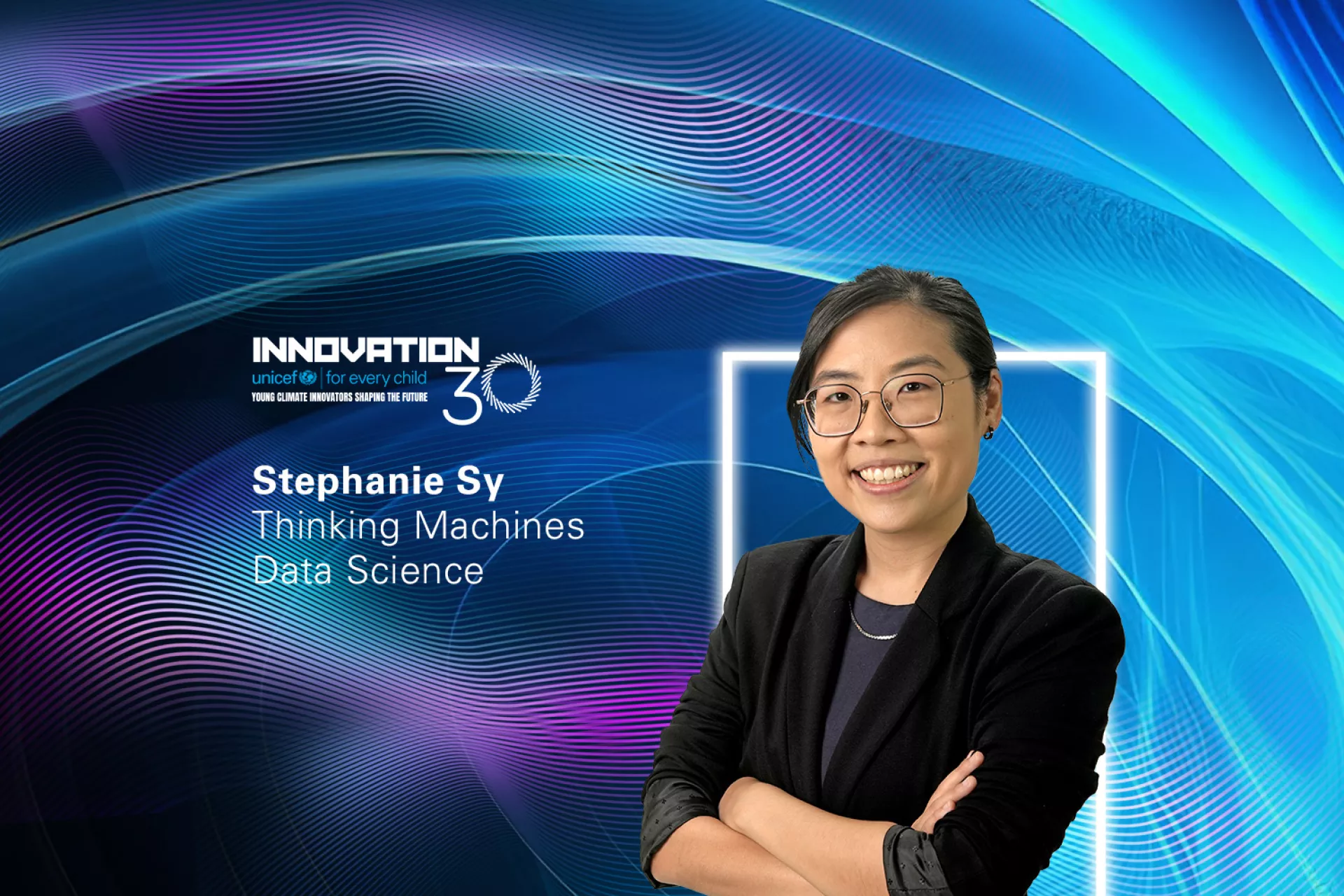
Stephanie Sy has been selected as part of UNICEF Innovation30: Young Innovators Shaping the Future.
Countries of Solution Deployment: Philippines, Thailand
Innovation Accelerator: UNICEF Venture Fund
Stephanie Sy, now 34, decided to return home to focus on her innovative enterprise Thinking Machines Data Science after graduating from Stanford and working with companies like Google in the San Francisco Bay. Her journey started many years earlier, in 2015, when she realized “data science was falling behind in her home country, and decided to develop a meaningful solution to help communities in the Philippines.”
Today, Stephanie and her team of over 80 people at Thinking Machines Data Science specialize in AI and geospatial datasets for climate and development. Initially, they focused on using high-resolution satellite imagery to capture poverty estimates in the Philippines. In 2021 they established a unique Sustainability Team to combine technical expertise and industry insights towards solutions that serve both climate goals and business needs.
Together with UNICEF East Asia and Pacific Regional Office, Stephanie’s team has built the Artificial Intelligence for Development (AI4D) Initiative, which consists of three open-source solutions.
The first, GeoWrangler, is a python library accelerating geospatial data analysis. The second provides relative wealth estimate and mapping models for 9 Southeast Asian countries, addressing the challenge of pairing reliable location-tagged ground truth data with nontraditional data – like satellite imagery and community-volunteered information – to surface robust insights for designing, implementing, and monitoring humanitarian programs.
The third uses machine learning to estimate haze or particulate matter (PM)2.5 in almost a thousand districts across Thailand. Fine particles in the air (measured as PM2.5) are so small that they can travel deeply into the respiratory tract, reaching the lungs and causing short-term health effects such as eye, nose, throat, lung irritation, and shortness of breath. The solution uses a combination of satellite data, low-cost sensors, and big data down to the district or village level.
With growing threats caused by climate change and 800 million children living in areas with unsafe levels of air pollution, the role of big data and AI in enabling decision-makers to target preventative and response efforts better is essential. “Data gives people who come from very different backgrounds and experiences a common ground on which to stand”, Stephanie says.
UNICEF does not endorse any company, brand, product, or service.


