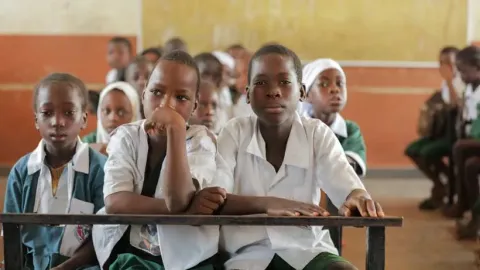
Cash transfers to vulnerable families ensure children go to school
Ensuring zero-out-of-school children in The Gambia

Banjul, 9 September 2024 – Ten-year-old Horija Bojang of Nioro Jattaba village in the Lower River Region in The Gambia suddenly dropped the broom, stood arms akimbo and speechless for a few moments. She had just received news from her aunt and carer that she will be going back to school.
“I am going back to school tomorrow!” she exclaimed hugging her aunt with a tight grip as she sobbed with tears of joy. “My dreams of becoming a nurse are going to finally be fulfilled.”
Horija’s education was facing severe challenges as not all of her needs and school materials could be adequately provided, and this made her miss classes sometimes. She had been staying with her aunt and carer, Awa Badjie, since she was five months old as her mother had developed mental health issues and had to be transferred to another community for treatment. As a schoolteacher, her aunt was determined to see her go to school, so she offered to raise her and see her through her education.
The Gambia, like many Sub-Saharan countries, struggles to ensure all children are in school, especially at the right age. Data from the Multiple Indicator Cluster Survey, 2018 indicates that less than one in four children aged between three- and five-years old attend Early Childhood Education (ECE). This, in turn, impacts on attendance at primary level. Girls are particularly at risk of dropping out of school mainly due to behaviours and practices that promote the education of boys over girls. Although enrolment rates for girls have increased, they still face barriers such as early marriage and cultural norms that prioritize boys' education. Only seven in ten girls now complete junior secondary school and proceed to senior secondary school.

UNICEF, in partnership with the Education Above All Foundation (EAA) and in collaboration with the Ministry of Basic and Senior Secondary Education, are facilitating a programme to support almost 40,000 out-of-school children of primary school age to enroll in school. Additionally, 4,074 children in 46 Majalis (Quranic education schools) are receiving Foundational Learning (Literacy and Numeracy lessons) to strengthen their cognitive development. Water, hygiene and sanitation services were also provided to the majalis to improve the sanitation facilities and support the healthy growth of children attending.
Moreover, the programme has facilitated cash transfers to parents of 7,500 out-of-school children in more than 100 communities to ensure that children go to school and complete their education. These cash transfers are used by families such as Horija’s to buy basic learning materials and settle other school charges such as uniform, school shoes and a meal in school.
“This is like a dream come true and I was not expecting it at all,” Horija said as the tears of joy rolled down her face. “I feel so good to go to school so that I can help develop my community.”
Horija’s joys were shared with many of her peers and their families in her community and surrounding villages who also received the same level of support. Her aunt who is also a primary school teacher, was pleased with this financial support as she often finds it extremely difficult to cater adequately for Horija since her low income cannot adequately support Horija’s needs.
“Without this cash transfer support, it would have been extremely difficult to continue to support Horija’s education as my salary is inadequate and I am on a sick leave at the moment,” said Awa Badjie, Horija’s aunt. “This support is a relief to many of us struggling families in vulnerable communities.”
“This Out-of-School programme is a demonstration of how we use an integrated approach to deliver the best results for children and their families,” said Nafisa Binte Shafique, UNICEF Representative in The Gambia. “We have used education as an entry point to integrate social protection systems and water, sanitation and hygiene (WASH) interventions in the best interests of the child.”
As Horija left for school the next day, she was assured of a conducive learning environment with school materials and access to water, sanitation, and hygiene facilities to keep her and thousands of her peers in school, to ensure their healthy growth and development.